



 Roller blinds
 Double roller blinds
 Roman blinds
 Venetian blinds
 Vertical blinds
 Panel blinds
 Order Free Samples
 Spare Parts
 How To Guides
 Book A Design Consultation
 Inspiration
 Upload Your Plans
 Curtains
 Double curtains
 Design PVC plantation shutters
 Design Australian PVC plantation shutters
 Design motorised roller blinds
 Design motorised curtains
 Success Stories
 Blogs
Blogs FAQ
FAQ

Vertical Blinds Buying Guide: What They Are and How to Choose
A vertical blind is a row of fabric vanes hanging from a track at the top of the window. Turn the wand and the vanes rotate together, from open to overlapping closed. Pull it along the track and they draw to one side and stack. That's the whole idea, and on a sliding door or a wide window nothing else does the job as neatly.
This guide covers where a vertical suits, where it doesn't, and the five choices in our designer: vane width, fabric and colour, control, stack and fit. It's all DIY. You measure, we make the blind to your sizes, and you fit it yourself with the brackets we send. You can see the whole range on our vertical blinds page.
How a vertical blind works
The track is powder-coated aluminium, 27mm high and 45mm deep. Inside it, a carrier holds each vane. The carriers are linked, so one twist of the control turns every vane at once, and one pull slides them all along the track.
At the bottom, each vane has its own weight to keep it hanging straight. Ours are chainless as standard, so nothing links the vanes along the bottom. You can also choose sewn-in weights, where the weight sits hidden inside the hem. Either way there's no bottom chain to tangle or rattle.
Because the vanes stack sideways instead of rolling up, width isn't a problem. We make a vertical up to 5,775mm wide in one piece, with a drop of up to 3,650mm, and when it's drawn back the glass is almost completely clear.
Is a vertical blind right for your window?
Verticals earn their place on three kinds of opening:
- Sliding doors. The vanes stack to the side that doesn't open, so you walk straight through. A roller over a slider has to go all the way up every time you step outside. Our blinds for sliding doors page compares every option we make.
- Wide windows and tall glass. One vertical spans what would otherwise take two or three rollers side by side.
- Rooms that need privacy and daylight together. Tilt the vanes part way and people outside see fabric, while light still comes in past the edge of each vane.
And they're the wrong pick for these:
- Bedrooms that must be dark. Our vanes are blockout fabric, but light still slips between them and around the edges. For sleep, go for blockout roller blinds or curtains.
- Small windows. The minimum width is 945mm. On anything narrower, a roller or venetian sits neater.
- Doors left open on windy days. Hanging vanes swing and tap together in a breeze. Some people like the sound; plenty don't.
Which vane width: 127mm or 89mm?
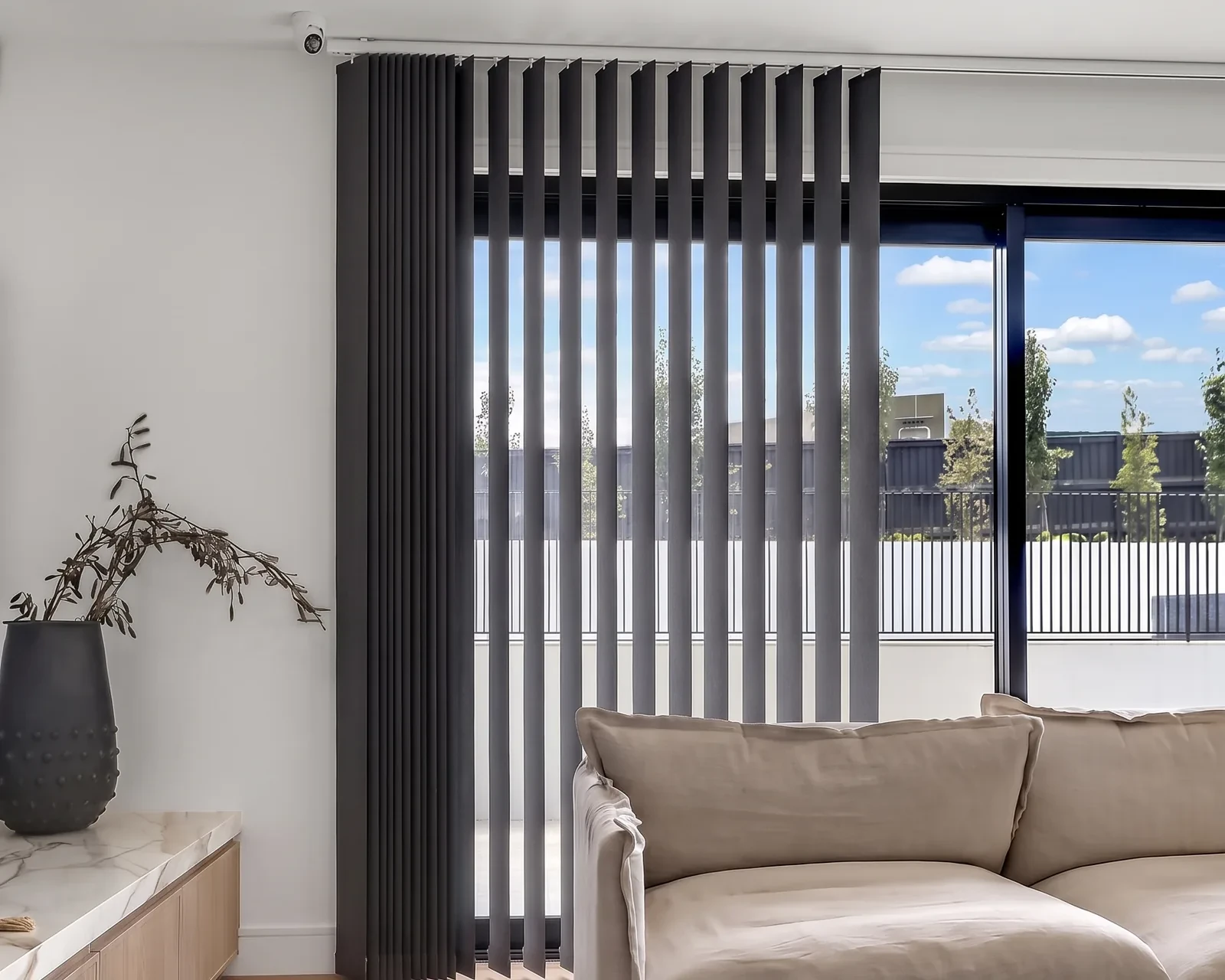
127mm is the standard in our vertical blind designer. Fewer, broader vanes mean fewer joins, and when you draw the blind back it stacks smallest, so more of the glass stays clear. It's the one we'd pick for sliding doors and wide windows.
89mm vanes are narrower, so there are more of them. They give a finer look on smaller windows, and they're the usual size if you're replacing an old blind like for like. They cost a little more than 127mm and take up slightly more room when stacked.
Which fabric and colour?
Every vertical we make is blockout fabric, in three ranges: Focus, Vibe and Balmoral. The range sets the texture and the price; the colour is just the colour. Focus and Vibe are very hardy fabrics, the ones to pick where a blind gets wet or dirty, like a kitchen or laundry door, and Focus can be wiped down.
We don't make light-filtering or PVC vertical vanes. If you want soft daylight more than privacy, a sheer curtain or a light-filtering roller blind will do that job better.
Colour is where people go wrong. Whites are the hard one, because a white vane beside a warm cream wall can look grey. Order free vertical blind samples (no code needed, and they post separately so they won't hold up an order). Hold each one flat against the wall beside the window in daylight, then again at night. Two rules rarely fail: match the window frame for a quiet look, or go one shade darker than the wall for definition. Dark blockouts stop light exactly as well as pale ones; they just show dust more.
Wand, or chain and cord?
A wand is one rod that does both jobs. Twist it to tilt the vanes, push or pull it to draw them. There's no loose cord, and it's what we'd choose for most homes.
Chain and cord splits the jobs: a chain tilts and a cord draws. It gives finer tilt control on very wide blinds, and the chain comes in white, black or grey. If you pick it, fit the chain tensioner that comes with the blind so the chain can't hang in a loop.
Then choose the control side. Stand inside the room facing the window and put the control where you can reach it without leaning over furniture. With two blinds side by side, put the controls on the outer edges.
Which way should the vanes stack?
- Left stack: all the vanes draw to the left.
- Right stack: all the vanes draw to the right.
- Centre stack: the vanes draw to the middle, leaving both edges clear.
- Split from the centre: the vanes part in the middle and draw to both sides, like a pair of curtains.
On a sliding door, stack to the side that doesn't open, so the vanes never swing into the doorway. On a window, stack away from the side you look out of.
Face fit or recess fit?
Face fit, outside the opening, is standard for verticals and the right call on most doors. The vanes hang below the track and swing as they turn, so a recess fit needs a deep opening with nothing poking into it: no handles, no winders, no security screen. If the recess is deep and clear, an inside fit looks neat and tucked away. If there's any doubt, go outside.
How to measure for a vertical blind
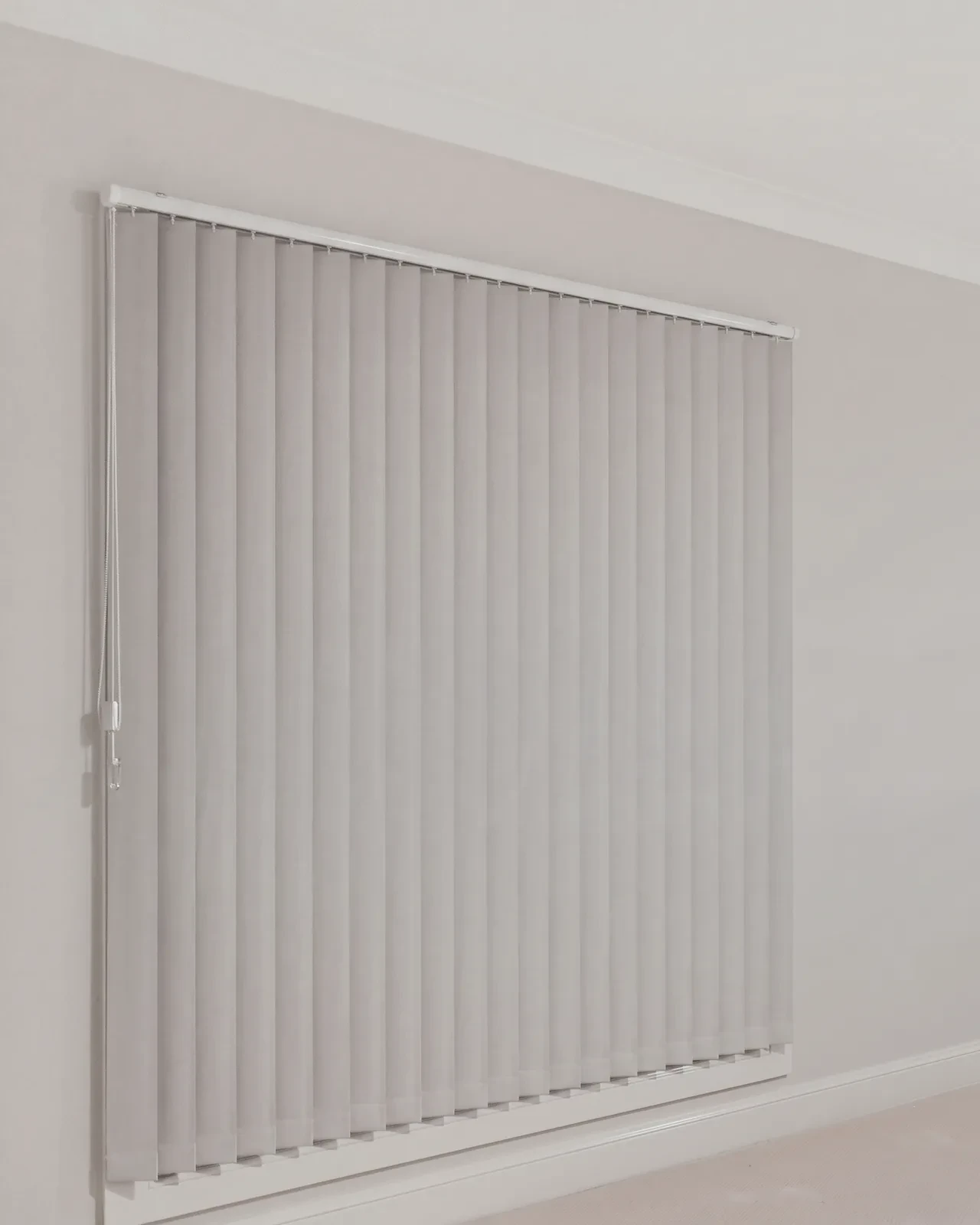
- Use a steel tape and write everything in millimetres. Measure every window, even if two look the same.
- Face fit: give us the size you want covered. Add at least 50mm each side and 70mm above the opening so the stacked vanes clear the glass.
- Recess fit: measure the width at the top, middle and bottom, and the drop at the left, centre and right. Give us the smallest of each, and we take the clearance off so the blind runs freely.
- Drop: from the top of the track to where you want the vanes to finish. Leave a little gap above the floor or sill so they can swing.
Give us the real numbers and we make every deduction. We check every order before it goes to the workshop, and we'll call you if a number looks odd. If you'd like a second pair of eyes, the Perfect Fit Guarantee is a paid add-on: we video call you to check your measurements before we make the blind. Our measuring guide has the diagrams.
Finishing touches
- Track colour: anodised, a brushed silver that suits aluminium frames; white, which disappears against a white ceiling; or black.
- Bottom weights: chainless weights are standard. Sewn-in weights hide the weight inside the hem for the cleanest finish, for a little extra.
Fitting it yourself
The brackets come with the blind, one type for face fit and another for recess fit. You'll need a drill, a pencil and screws to suit your wall or frame.
- Screw the two outer brackets about 2cm in from each end. On a face fit, line the top of the bracket up with the top of the architrave. On a recess fit, line the front of the bracket up with the front of the window frame. Space the rest evenly between them.
- Hook the front of the track into the brackets, roll it back and click the back into place.
- Twist the rods so the vane clips sit at 90 degrees to the wall, then hang the vanes one at a time.
- Test it. If the vanes ever drift out of line, twist them all the way one way, then all the way the other, and they'll line up again.
Our vertical blind install guide has the video and the PDF instructions for face fit and both vane widths. And if a hanger or weight breaks years from now, you don't need a new blind: our vertical blind spare parts cover blade hangers, chainless and sewn-in weights, carriers and end caps.
Vertical, panel glide or curtain for a sliding door?
If a vertical doesn't feel right for a wide opening, look at panel glide blinds or S-fold curtains on a track.
| Vertical blind | Panel glide | S-fold curtain | |
|---|---|---|---|
| Clears the glass when open | Almost fully, vanes stack to one side | Partly, panels stack behind each other | Fully, if the track runs past the opening |
| Privacy and light together | Yes, tilt the vanes | No, panels are open or closed | Yes, with a sheer |
| Darkness | Light between the vanes | Some light at the edges | Good in blockout |
| Look | Clean vertical lines | Flat, modern panels | Soft and finished |
Common questions
What are vertical blinds?
A row of fabric vanes hanging from a track. The vanes tilt to control light and privacy, and draw to one side to clear the window or door.
Are vertical blinds out of date?
The old beige office ones, maybe. A blockout fabric vane in a warm neutral on a sliding door looks current, and nothing else clears a slider as well.
Do vertical blinds block out light?
Not completely. Our vanes are blockout fabric, but light passes between the vanes and around the edges. Use a blockout roller or curtain where a room must be dark.
Do your vertical blinds have a bottom chain?
No. Chainless weights are standard and sewn-in weights are an option, so nothing links the vanes along the bottom.
Can I install a vertical blind myself?
Yes. Screw in the brackets, click in the track and hang the vanes. The install guide walks you through it with a video.
How long does a vertical blind take to arrive?
Each one is made to your sizes in Australia and is usually dispatched within 8 to 15 business days. It comes with a 5-year warranty.
Design your vertical blind
Blockout fabric vanes, made to measure in Australia, 5-year warranty. See your price in the designer, or start with free samples.
You may also like

You may also like
Subscribe for new fabrics and install tips.
One email a month: new fabrics, install tips, the occasional honest before/after.
No spam, no daily-deal noise.

It’s never too early to consider window furnishings when you’re planning on renovating or building. Our expert team of design consultants can help create unique solutions and seamless designs and even quote directly off your house plans.





More Info
InspirationAbout UsContact UsOur ArticlesSuccess StoriesPerfect Fit GuaranteeDelivery InformationCustomer ReviewsFrequently Asked QuestionsGet in Touch
Address: 16 Bradwardine Road, Robin Hill NSW 2795
Email: hello@homeblindsaustralia.com.au
Phone: 1300 195 797
More Info
InspirationAbout UsContact UsOur ArticlesSuccess StoriesPerfect Fit GuaranteeShipping & Return PolicyCustomer ReviewsFrequently Asked QuestionsGet in Touch
Address: 16 Bradwardine Road, Robin Hill NSW 2795
Email: hello@homeblindsaustralia.com.au
Phone: 1300 195 797
© Copyright Home Blinds Australia 2026. All Rights Reserved.
Payments Accepted:
