



 Roller blinds
 Double roller blinds
 Roman blinds
 Venetian blinds
 Vertical blinds
 Panel blinds
 Order Free Samples
 Spare Parts
 How To Guides
 Book A Design Consultation
 Inspiration
 Upload Your Plans
 Curtains
 Double curtains

 Design PVC plantation shutters
 Design Australian PVC plantation shutters

 Design motorised roller blinds
 Design motorised curtains
 Success Stories
 Blogs
 FAQ
Complete step-by-step instructions for perfect Installation
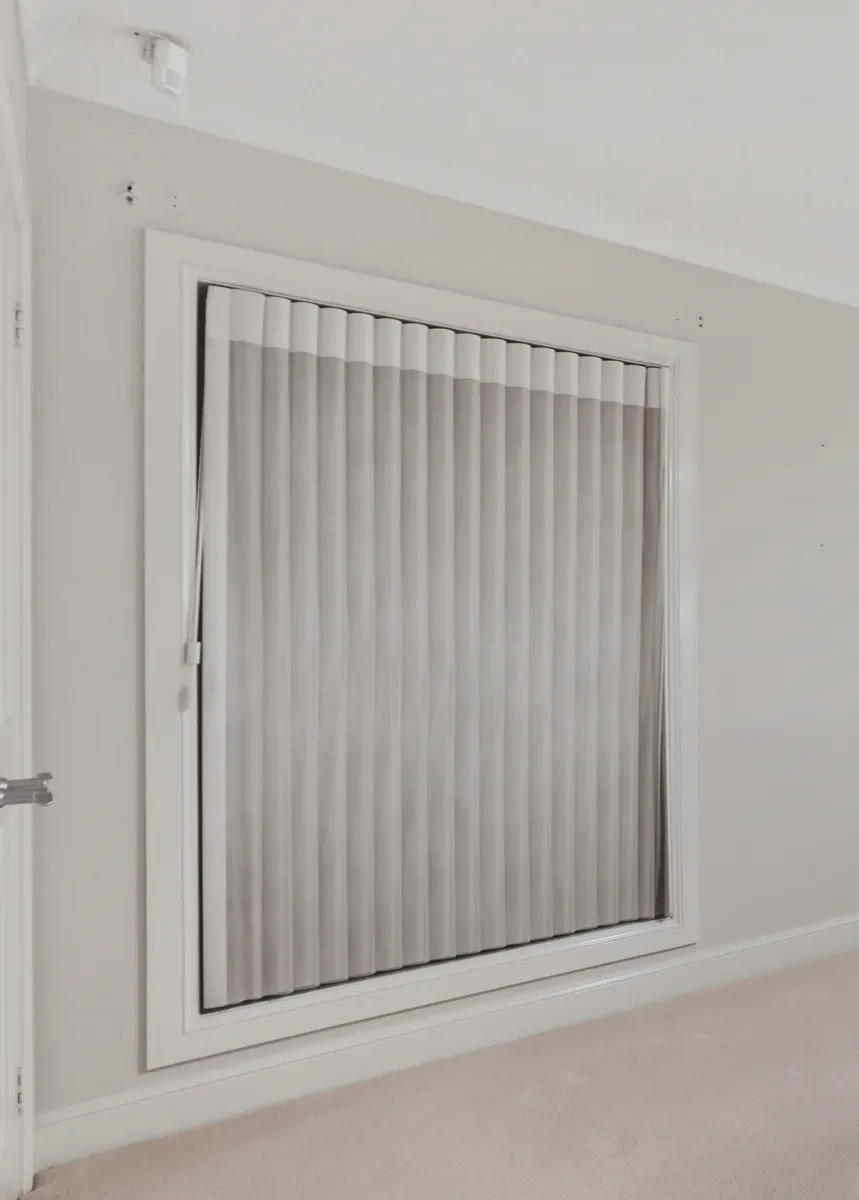
How to Install Vertical Blinds
Putting up a vertical blind takes about 20 to 30 minutes. You fix the brackets, clip the track in, turn the carriers side-on and hang the vanes one at a time. These are the steps for the vertical blinds we make, face fit or recess fit, with a wand or a chain and cord. They're DIY made to measure: we make yours to your sizes in Australia, and you fit it yourself.
Before you start
- Time: 20 to 30 minutes a blind once it's unpacked.
- Tools: a drill with a bit to suit your wall, a driver bit or screwdriver, a steel tape, a pencil and a step ladder. A spirit level helps on a long track.
- A second person for a wide sliding door. Our tracks go up to 5,775 mm in one piece, and someone holding the far end makes clipping it in much easier. The wider 127 mm vanes are heavier, too.
- Fixings for your wall. We don't include screws or plugs, because every wall is different. Timber takes timber screws straight in. On plasterboard, find a stud or use a rated hollow-wall anchor. Brick, concrete and tile need a masonry bit and matching plugs. Not sure what's behind the paint? Send us a photo and we'll tell you.
Unpack everything on the floor under the window and check it off: the track, the brackets, the vanes, and the tensioner if you ordered chain and cord. If anything's missing, tell us before you open the fabric.
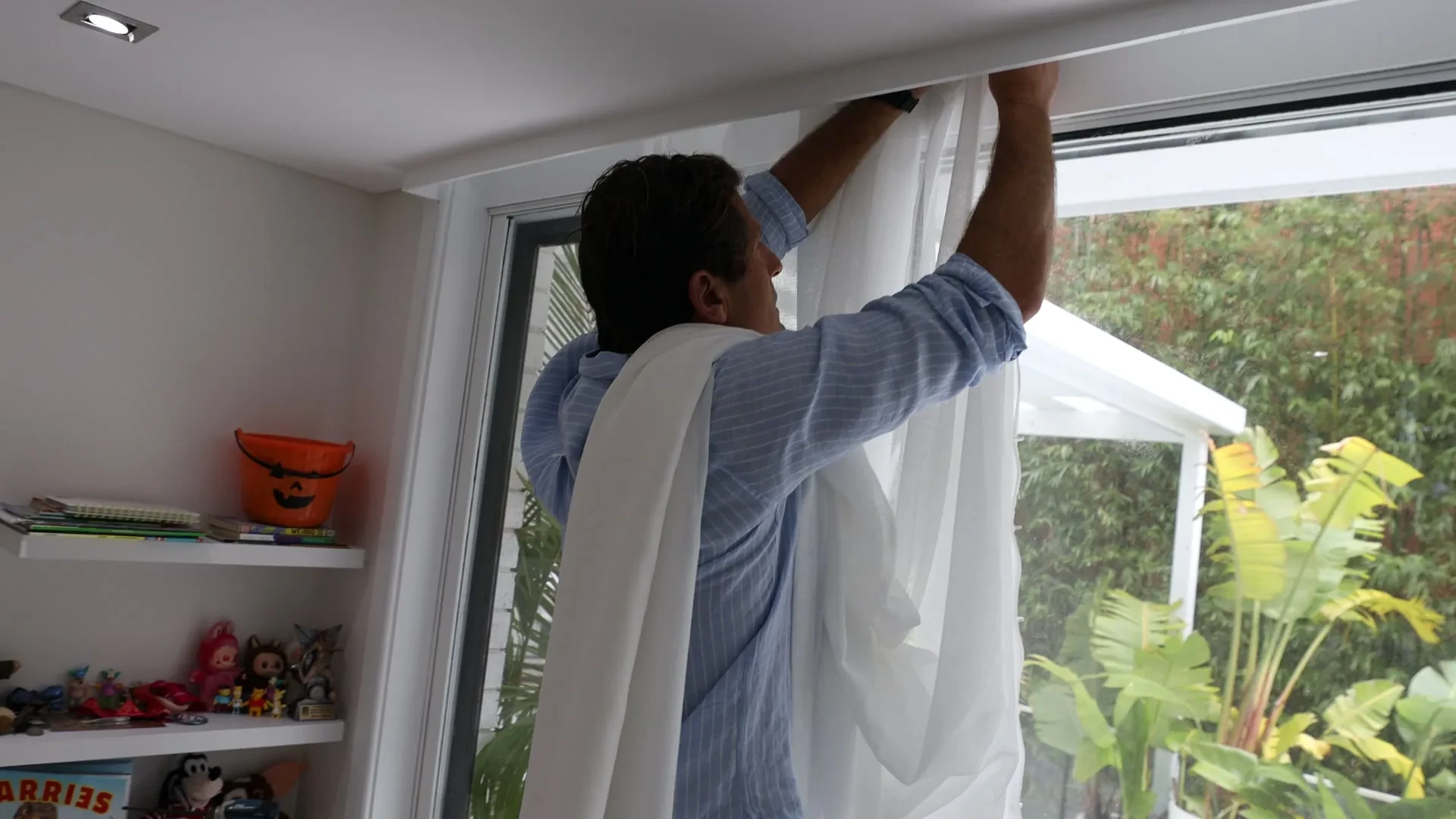
Step 1: Put the brackets up
Check which end the wand or chain hangs from (the side you chose when you ordered), so you know which way round the track goes up.
Face fit: on the wall or architrave
Face fit is standard for verticals and the usual choice on a sliding door. The brackets screw to the wall or architrave in front of the window, with the top of each bracket level with the top of the architrave. Set the two end brackets 40 to 60 mm in from each end of the track, then space the rest evenly between them, one every 1.5 m or closer.
Recess fit: inside the opening
For recess fit, the clips screw up into the top of the window opening, with the front of each one in line with the front of the window frame. The spacing is the same as face fit. The vanes hang below the track and swing as they turn, so check no handle, winder or security screen is in their way.
- Mark through the holes in each bracket with a pencil.
- Drill, plug the holes if your wall needs it, and screw the brackets on.
- Sight along the row before you go on. Every bracket needs to sit on one line, and it's much quicker to fix one now than to take the whole blind down later.
Step 2: Clip the track in
Lift the track up and hook its front edge into each bracket, then roll the back of the track up until it clicks. Run your hand along and check every bracket has closed properly, because one that's only half shut can let go weeks later. On a wide door, work from one end while your helper holds the other.
Step 3: How to hang vertical blinds (the vanes)
- Turn the carriers side-on. Twist the wand, or pull the tilt chain, until the clips that hold the vanes sit at 90 degrees to the wall. Now every carrier faces the same way, which is what lets the vanes close flush later.
- Hang the vanes one at a time. Start at one end and work across. Hook the top of each vane into its clip until it holds, then let it hang.
- Keep them all the same way round as the first one, so the hems line up across the blind.
There's no chain to join along the bottom. Our vanes have chainless weights as standard, one in each vane with nothing linking them, or sewn-in weights hidden in the hem if you chose those. Each vane hangs straight on its own.
Step 4: Fit the tensioner and test it
With a wand there's no loose cord to deal with: one rod twists the vanes and draws them. With chain and cord, the chain tilts the vanes and the cord draws them. Screw the tensioner that comes with the blind to the wall or frame at the bottom of the loop, so the loop is held taut. Don't skip it.
Now test it. Draw the vanes all the way across and back, then tilt them open and closed. If they've drifted out of line, turn the wand (or pull the chain) all the way to the left, then all the way to the right, and they'll line up again.
How to measure for vertical blinds
Measure the window, not the old blind, in millimetres with a steel tape. Take the width in three places and the drop in three, starting at the top where the brackets go.
- Face fit: give us the size you want covered, at least 50 mm past each side and 70 mm above the opening.
- Recess fit: give us the smallest width and drop, with nothing taken off. We take off the clearance the vanes need.
- Drop: from where the track sits to where the vanes should finish. Leave a small gap above the floor or sill so they swing freely.
On a sliding door, stack the vanes to the side that doesn't open, so they never swing into the doorway. There's more in our blinds for sliding doors guide, and the measuring guide has a video and the sizes we make each blind in.
Still choosing a colour? Order free vertical blind samples and hold them against the window in daylight and at night. All our vertical blinds are blockout fabric: Focus, Vibe or Balmoral. Focus and Vibe are very hardy, and Focus can be wiped down.
How to remove vertical blinds
Vanes first, then the track.
- Turn the vanes open so the clips sit at 90 degrees to the wall.
- Unclip the vanes one at a time and lay them flat. Most let go if you lift the vane slightly and ease it towards you.
- Press the release tab on each bracket and roll the track forward off it.
Our guide to removing blinds covers rollers, venetians and the rest, plus filling the old holes.
Printable instructions
Pick the PDF that matches your order: face fit, or recess fit with 89 mm or 127 mm vanes.

Common questions
How do you put a vertical blind vane back on?
Turn the wand (or pull the tilt chain) until the clips sit at 90 degrees to the wall, then hook the top of the vane back into its clip. If one keeps dropping off, its hanger may be worn or cracked. We sell replacement blade hangers for both vane widths, plus runner connectors and end caps, in vertical blind parts.
Why won't my vertical blinds close flush?
Usually a carrier is turned the wrong way. Turn the wand all the way to the left, then all the way to the right, and the vanes should line up again. If one still won't sit flush, get in touch before you force it.
How do you put vertical blinds into the brackets?
Hook the front edge of the track into each bracket, then roll the back up until it clicks. If it won't click, a bracket is out of line: sight along them and re-fix the odd one out rather than forcing the track.
Can vertical blinds go inside the window frame?
Yes, if the opening is deep enough. The vanes hang below the track and swing as they turn, so nothing can stick into the opening: no handles, winders or security screens. If you're unsure, or the recess is shallow, fit them outside the opening, which is standard for verticals.
Choose your fabric, fit and controls, and see the price as you go. Made to measure in Australia; you measure and fit it yourself.
Subscribe for new fabrics and install tips.
One email a month: new fabrics, install tips, the occasional honest before/after.
No spam, no daily-deal noise.

It’s never too early to consider window furnishings when you’re planning on renovating or building. Our expert team of design consultants can help create unique solutions and seamless designs and even quote directly off your house plans.





More Info
InspirationAbout UsContact UsOur ArticlesSuccess StoriesPerfect Fit GuaranteeDelivery InformationCustomer ReviewsFrequently Asked QuestionsGet in Touch
Address: 16 Bradwardine Road, Robin Hill NSW 2795
Email: hello@homeblindsaustralia.com.au
Phone: 1300 195 797
More Info
InspirationAbout UsContact UsOur ArticlesSuccess StoriesPerfect Fit GuaranteeShipping & Return PolicyCustomer ReviewsFrequently Asked QuestionsGet in Touch
Address: 16 Bradwardine Road, Robin Hill NSW 2795
Email: hello@homeblindsaustralia.com.au
Phone: 1300 195 797
© Copyright Home Blinds Australia 2026. All Rights Reserved.
Payments Accepted:
