



 Roller blinds
 Double roller blinds
 Roman blinds
 Venetian blinds
 Vertical blinds
 Panel blinds
 Order Free Samples
 Spare Parts
 How To Guides
 Book A Design Consultation
 Inspiration
 Upload Your Plans
 Curtains
 Double curtains
 Design PVC plantation shutters
 Design Australian PVC plantation shutters
 Design motorised roller blinds
 Design motorised curtains
 Success Stories
 Blogs
Blogs FAQ
FAQ

Sheer Curtains and Roller Blinds Together — The Layered Window Look
Walk through a run of newly renovated Australian living rooms and you'll see the same window setup over and over: a sheer curtain hanging floor to ceiling at the front, a blockout roller blind tucked tight to the glass behind it. It's the look everyone is asking for, and it's the look that actually works.
This guide walks through why the combination has become the default, how to set it up, how to choose fabrics that work together, when to motorise (and which layer), and the practical install order.
Why this combination works
Sheer curtains and roller blinds together solve a problem either one does poorly alone. A sheer by itself gives no night-time privacy; a roller by itself gives no soft daytime look. Together, the sheer handles daytime softness and privacy while the roller handles night-time blockout and insulation.
A sheer curtain hanging on its own has one job: diffuse light and give daytime privacy. It does that beautifully, and Australian living rooms have valued sheers for years for exactly that reason. The problem is what happens at night. When the interior lights come on and the outside light fades, the same fabric that looked opaque by day becomes transparent. Anyone standing outside can see straight in. A sheer alone isn't a night-time privacy product.
The traditional fix was a double-track curtain set — sheer at the front, blockout curtain behind, on parallel tracks. It works, but it's visually heavy, costs more, and needs more wall depth than many modern homes have. A blockout roller close to the glass replaces the back curtain. The roller fits tight in the window recess, the sheer hangs softly in front, and you get daytime softness and night-time blockout in a much slimmer profile.
Four reasons it's everywhere right now
- Slimmer profile. The roller sits in the recess; the sheer hangs from a ceiling-mounted track in front. The total wall depth needed is less than a double-track curtain set.
- Lower cost than a double-track curtain. A blockout roller is usually less expensive than a lined blockout curtain of the same width, so the layered combination often comes in under the equivalent double curtain.
- Easier motorisation. The roller is the layer you operate most — closed at night, open by day. Motorising the roller is cheaper and more retrofit-friendly than motorising both curtain layers.
- The sheer becomes a fixed feature. With the roller doing the privacy and blockout job, the sheer doesn't have to be drawn and undrawn every day. Most homes leave the sheer closed as a soft visual feature and operate only the roller. Less wear on the sheer, and the room reads the same all day.
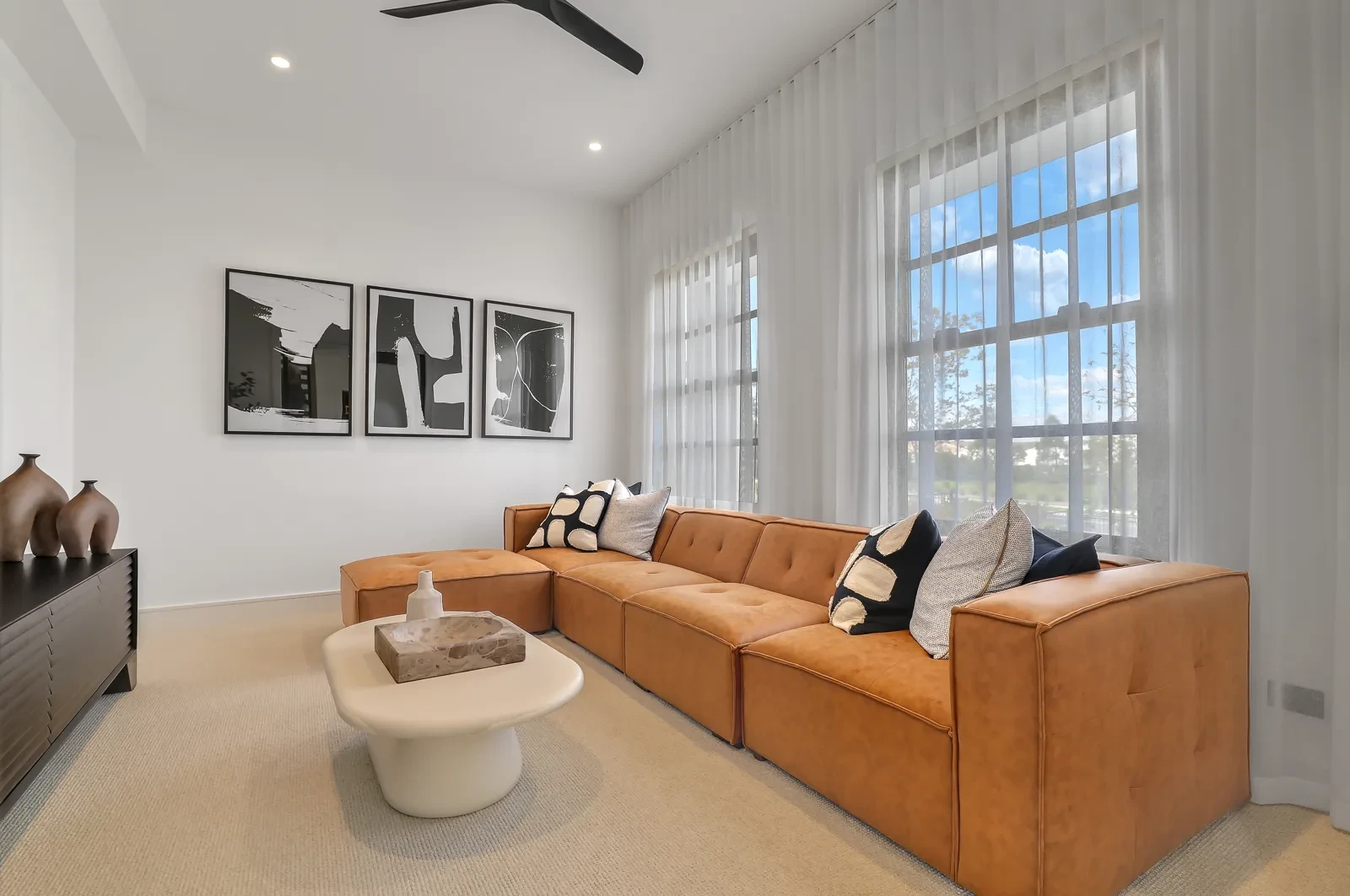
Sheers as the fixed layer in a Better Built living room at Menangle. They stay closed; the rollers behind do the day-to-night work.
How to choose the two layers
Choose the sheer first — it's the layer you see by day — then pick a blockout roller in the same tonal family or one step warmer. Linen-look sheers in oat or bone pair with matte blockout rollers in similar warm neutrals. The pairing fails when the sheer and the roller fight each other for attention. It works when they read as one considered choice.
Picking the sheer
The sheer is what guests notice. Pick a fabric you'd be happy with even if the roller didn't exist. A linen-look sheer in a warm neutral is the dominant choice right now, and our sheer curtains are made to measure with an S-fold heading on a ceiling- or wall-mounted track.
Picking the roller
The roller does the heavy lifting and is mostly hidden behind the sheer during the day. Choose a blockout in a tone close to, or slightly warmer than, the sheer (the roller blinds buying guide covers fabrics and fit). A cool-white roller behind a warm-cream sheer will fight; a warm-bone roller behind a warm-cream sheer reads as a soft shadow. If you want the view kept during the day as well, a double roller — sunscreen at the front, blockout behind — sits behind the sheer just as neatly.
Finish
Pair matte with matte. A high-sheen blockout behind a textured linen-look sheer looks mismatched even when the tones are right. Both layers should share a finish character.
Order free samples of both fabrics in one go and look at them side by side in your own room, at a few different times of day, before deciding. Hold the sheer up to the glass and the blockout behind it.
Install order and mount setup
Install the blockout roller first, recess-mounted inside the window frame and close to the glass. Then install the sheer curtain track second, ceiling-mounted (or wall-mounted just above the window) and set forward so the sheer hangs in front of the roller, not in line with it.
- Recess-mount the roller. Inside the window frame, brackets to the top of the recess. This puts the fabric tight to the glass and removes most of the edge light. If the recess is too shallow (you need about 60mm for a single roller, 125mm for a double), face-fit the roller to the wall just above the window instead.
- Ceiling-mount the sheer track. Set it forward of the window so there's room for the roller behind — aim for roughly 100–150mm of clearance so the sheer never touches the roller when either is moving.
- Track length. Run the track 100–200mm past the window on each side so the curtain finishes cleanly at the edges when it's drawn. The roller stays the width of the recess.
- Curtain length. Floor to ceiling is the modern default. The sheer hangs from the ceiling track to just clear the floor, or puddles 50–100mm for a softer look. Anything shorter and the proportion fails.
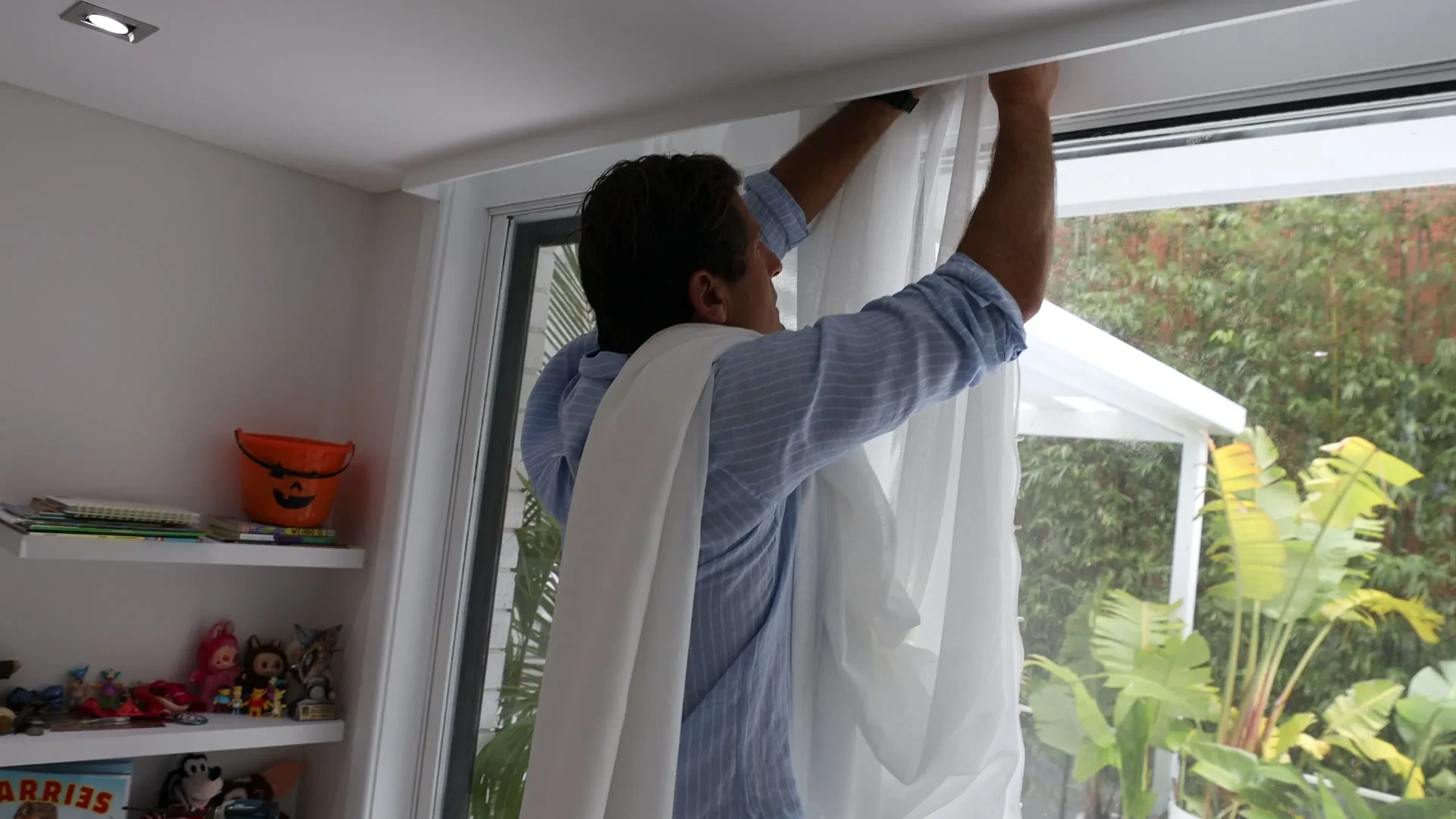
Harries hanging the sheer at his and Emily's place in Bondi — track up second, after the rollers went in.
Our measuring and install guides cover both the roller and the track, with videos. We don't supply screws or plugs because every ceiling and wall is different; pick fixings for your surface before install day.
Which layer to motorise
Motorise the blockout roller first. It's the layer you operate most — down at night, up by day — and a battery motor from Somfy or Acmeda goes in without an electrician. Schedule it to drop at sunset and lift at sunrise and the room runs itself. The sheer can stay manual; in most homes it's closed most of the day anyway.
Motorise the sheer too if you want full hands-free operation (scenes and voice control of both layers together), if the window is hard to reach, or if the sheer is so wide it's tiring to draw by hand. Our motorisation guide goes through the motors, remotes and hubs.
Where the combination earns its keep
- Living rooms — the main application. Sheer for soft daytime light, blockout roller for evening privacy and west-facing summer heat.
- Main bedrooms — same combination, with the roller pulling extra weight for a dark sleep. Pair with a motor.
- Open-plan dining — carry one sheer continuously across several windows, with a roller on each window behind. It reads as one soft wall of fabric.
- Kids' bedrooms — motorise the blockout roller, leave the sheer manual. No chain in the room, and a scheduled nap-time drop. Our nursery blinds guide has the cord-safety detail.
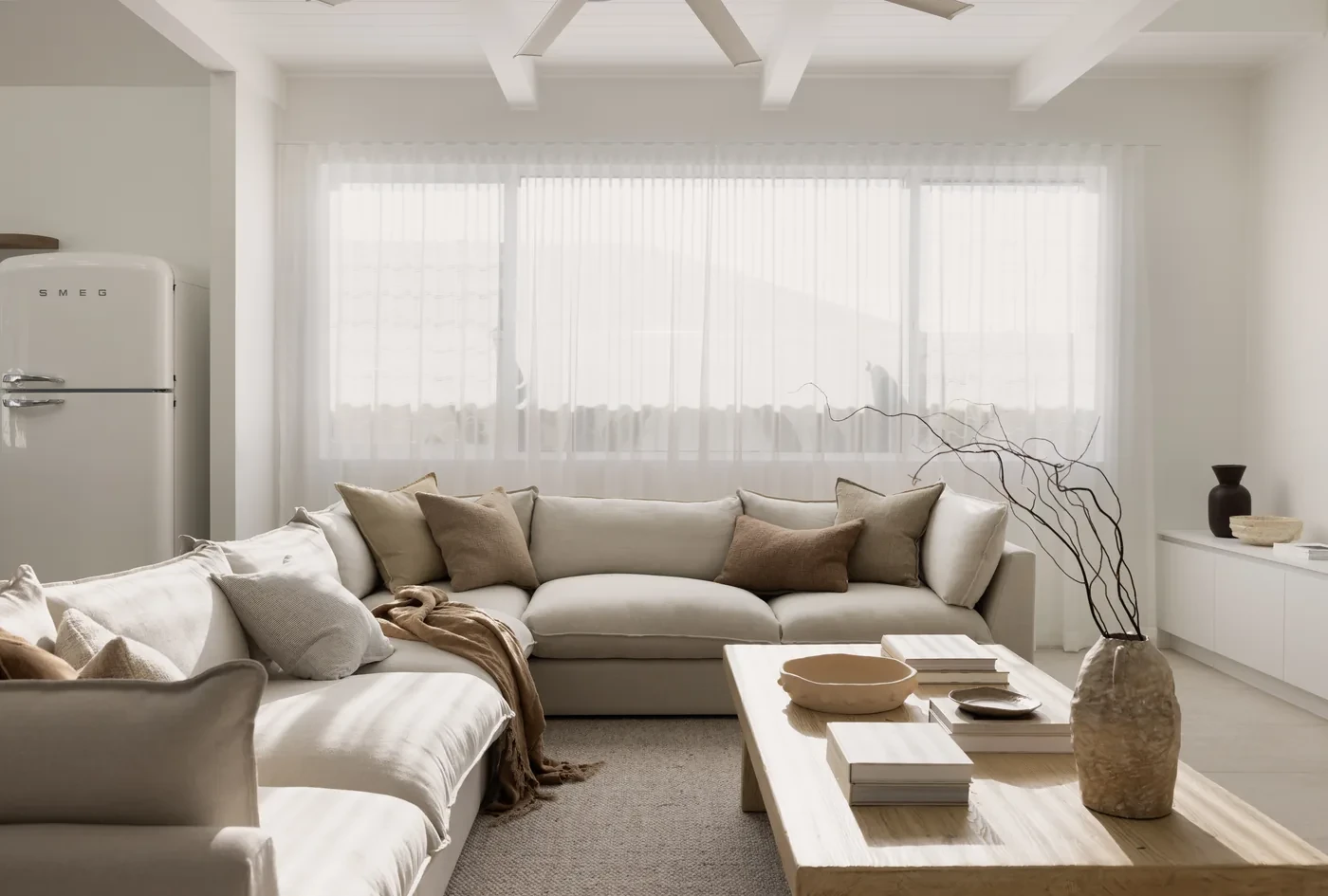
One continuous sheer across the living room at Oak & Orange's Dream Home 10 — the open-plan version of the look.
Common questions
Sheer in front or sheer behind?
Sheer in front, roller behind. The roller does the privacy work close to the glass; the sheer hangs softly in front and is what you see by day.
Will the roller show through the sheer?
Slightly, as a soft shadow. In the right tonal pairing it reads as part of the layered look rather than a competing element. Keep both in the same tonal family.
Can I add a sheer in front of a roller I already have?
Usually yes. Measure the depth from the wall to the front of the roller's bracket and set the ceiling track far enough forward to clear it — 100–150mm is the comfortable range.
What wall depth do I need?
Less than a double-track curtain set. Roughly 100–150mm between the back of the sheer track and the front of the roller. Most Australian windows accommodate this easily.
Do I need side tracks for a blockout roller blind?
We don’t make side tracks. You can still get a dark room without them: fit the roller inside the recess, close to the glass, or face-fit it wider than the window. A pelmet or a blockout curtain in front cuts the light at the edges even more. See every blockout blind we make
Should both layers be the same colour?
Same tonal family, not identical. A slightly warmer roller behind a warm sheer reads as a considered pairing; a cool roller behind a warm sheer fights it.
Is this more expensive than curtains alone?
A sheer plus a blockout roller usually costs less than a sheer plus a lined blockout curtain on a double track, with a slimmer profile and easier motorisation. The configurators price both live for your sizes, and our online vs showroom comparison explains where the price gap comes from.
Order free sheer and blockout samples
Both layers are made to measure in Australia — sheer curtains and blockout roller blinds — with a five-year warranty and the optional Perfect Fit Guarantee.
You may also like

You may also like
Subscribe for new fabrics and install tips.
One email a month: new fabrics, install tips, the occasional honest before/after.
No spam, no daily-deal noise.

It’s never too early to consider window furnishings when you’re planning on renovating or building. Our expert team of design consultants can help create unique solutions and seamless designs and even quote directly off your house plans.





More Info
InspirationAbout UsContact UsOur ArticlesSuccess StoriesPerfect Fit GuaranteeDelivery InformationCustomer ReviewsFrequently Asked QuestionsGet in Touch
Address: 16 Bradwardine Road, Robin Hill NSW 2795
Email: hello@homeblindsaustralia.com.au
Phone: 1300 195 797
More Info
InspirationAbout UsContact UsOur ArticlesSuccess StoriesPerfect Fit GuaranteeShipping & Return PolicyCustomer ReviewsFrequently Asked QuestionsGet in Touch
Address: 16 Bradwardine Road, Robin Hill NSW 2795
Email: hello@homeblindsaustralia.com.au
Phone: 1300 195 797
© Copyright Home Blinds Australia 2026. All Rights Reserved.
Payments Accepted:
