



 Roller blinds
 Double roller blinds
 Roman blinds
 Venetian blinds
 Vertical blinds
 Panel blinds
 Order Free Samples
 Spare Parts
 How To Guides
 Book A Design Consultation
 Inspiration
 Upload Your Plans
 Curtains
 Double curtains
 Design PVC plantation shutters
 Design Australian PVC plantation shutters
 Design motorised roller blinds
 Design motorised curtains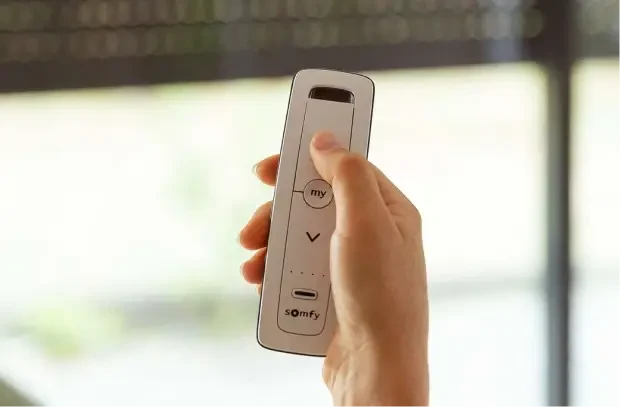
 Success Stories
 Blogs
Blogs FAQ
FAQ

Nursery Blinds and Curtains: How to Black Out a Baby's Room
A nursery blind has two jobs. It has to make the room properly dark at 1 pm for a day sleep, and it has to be safe for a kid who will, at some point, climb everything. Most window coverings do one of those well. Here's how to get both, with what we actually make.
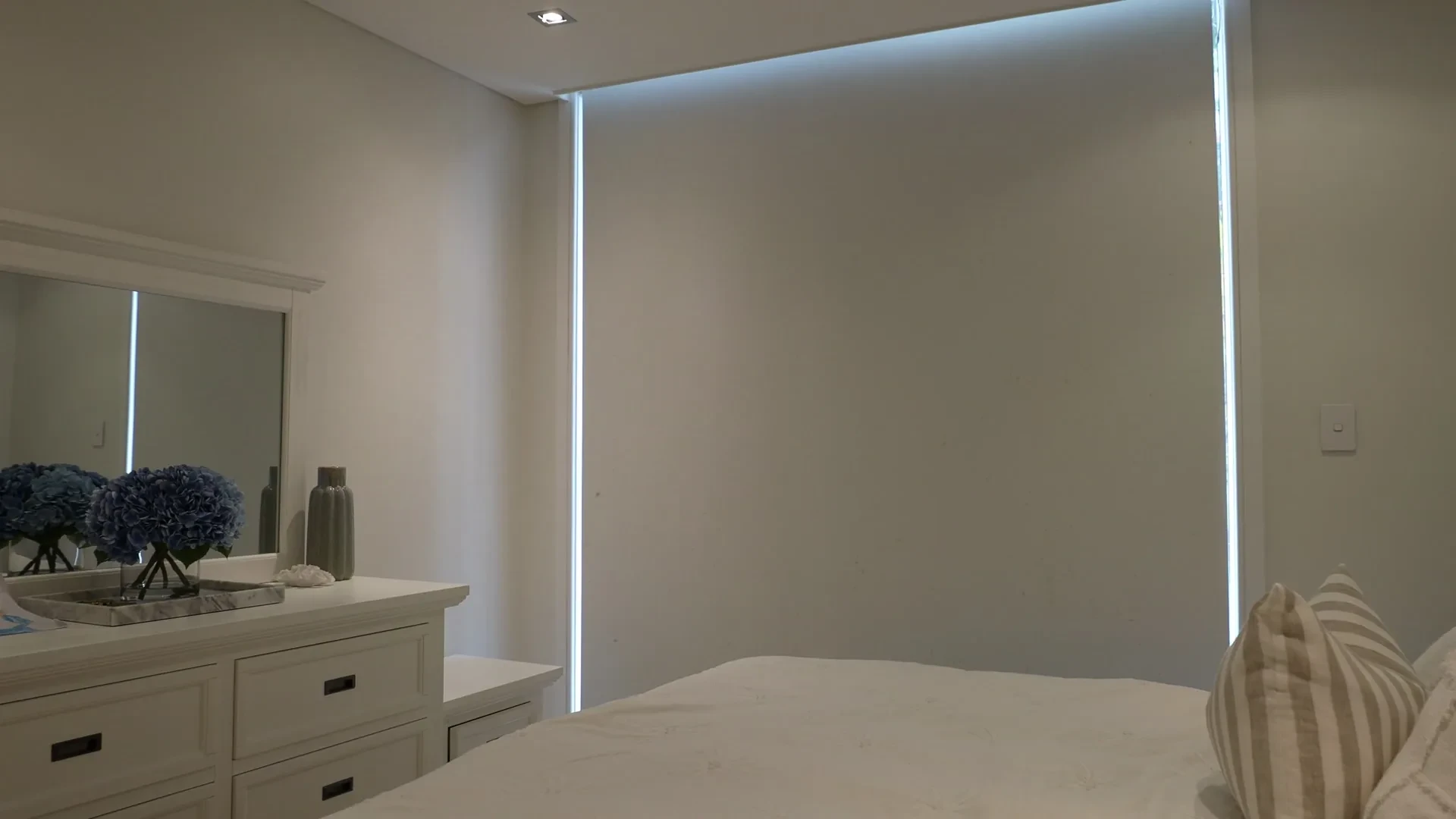
The kids' room at Harries and Emily's place in Bondi: a blockout roller down for a day sleep. The thin lines at the edges are what a recess fit leaves — read on for how to lose them.
Which blind actually blocks the light in a nursery?
A blockout roller blind, fitted so it overlaps the window. That's the honest answer for nine nurseries out of ten. The fabric itself is opaque — a coated blockout like our Focus range lets no light through the cloth at all — so the only light that gets in comes around the edges. Which means the fit matters more than the fabric. (Real blockout installs, including this room; the roller blinds buying guide covers fit and options.)
The other option that works is a double curtain: a sheer at the front for the day, a blockout curtain behind it for sleeps. Curtains hang past the window on every side, so they beat rollers on light gaps without any extra hardware. They cost more, take longer to make, and they're a fabric a toddler can pull on — so we usually suggest them for a room the child will grow into rather than a cot room. Prefer soft fabric folds? Our roman blinds come in blockout too. They lift on a chain or cord, so the cord-safety rules below apply to them as well.
What doesn't work on its own: sheers, light-filtering fabrics, venetians and vertical blinds. Lovely in the right room. Not dark enough for a 1 pm sleep. Light gets between the slats and the vanes, and venetians have a lift cord. (Night privacy is a separate question — here's how each fabric behaves after dark.)
Stopping the light gaps
This is the part people skip, then they order a blockout blind and wonder why the room is still striped with light at 6 am. A roller blind fitted inside the window recess leaves a gap of roughly 10–15mm each side, because the fabric is narrower than the brackets. That's fine in a lounge. In a nursery it's a problem.
Three ways to fix it, from least effort to most complete:
- Face fit instead of recess fit. Mount the blind on the wall or architrave above the window and make it at least 50mm wider than the opening each side, and 100mm taller. The fabric now covers the whole hole and the light has nowhere to leak. This is the single most useful decision for a nursery and it costs nothing extra.
- Add a pelmet or cassette. Light also sneaks over the top of the roll. A pelmet (a shallow box over the top of the blind) closes that gap and hides the hardware. You'll see it as an option when you configure a roller.
- Layer a curtain over it. A blockout roller for the dark, a curtain in front for the last few percent and for softening the room. This is what the double curtain track does in one product, or you can pair a roller with a single curtain.
Choose a darker fabric colour for a nursery blind. A white blockout is still fully opaque, but a pale fabric glows slightly at the edges where light bends around it. Charcoal, slate or a mid-grey reads darker in the room for the same fabric. Order a couple of colours as free samples and hold them up in the actual room at midday.
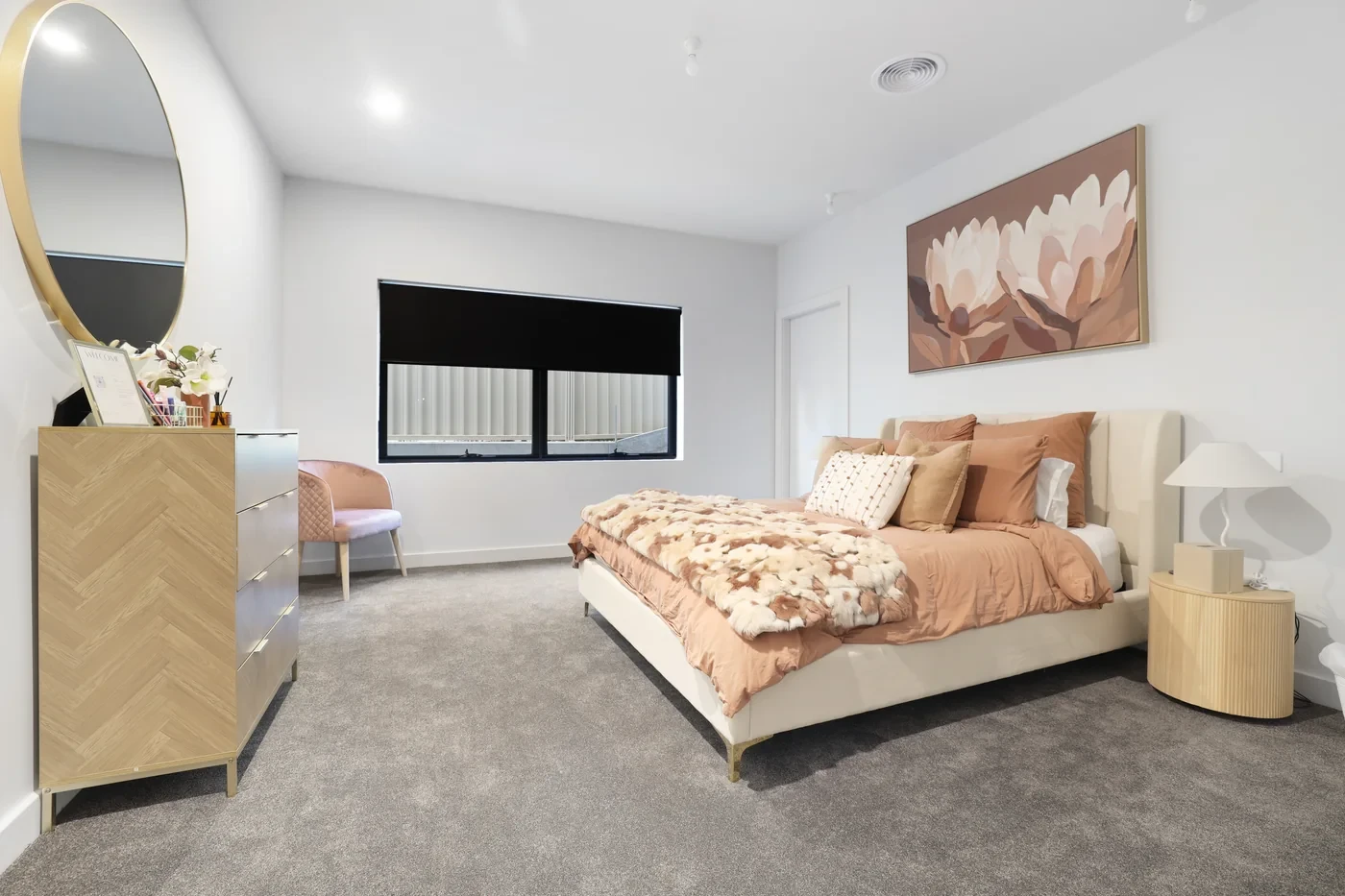
A black blockout roller in a bedroom. Dark fabrics read darker at the edges than pale ones — same opacity, less glow.
The cord-safety rules, in plain English
Australia has a mandatory standard for corded internal window coverings, and it exists because looped cords have strangled children. It applies to blinds sold and installed in homes, and it's the bit of a nursery job you don't improvise. The parts that matter to you as the person doing the install:
- Any chain or cord loop that can hang within 1.6 metres of the floor must be held taut against the wall with a tensioner (the little P-clip that comes with your roller). Fit it. It's not optional. See the warranty for what's covered.
- The warning label on the blind stays on. Don't cut it off because it looks untidy.
- Never put a cot, bed or climbable furniture under a window with a reachable cord or chain. The safest cord is one the child physically can't get to.
The cleanest way through all of that is to take the cord out of the equation. Our motorised roller blinds run on a rechargeable battery motor (Somfy or Acmeda Automate) with a remote — no chain at all, and you can lower the blind from the hallway without going in. It's more money than a chain-drive roller, and you'll recharge it with a USB cable, about twice a year, but for a cot room it takes the chain out of the room rather than managing it. Our motorisation guide goes through the options.
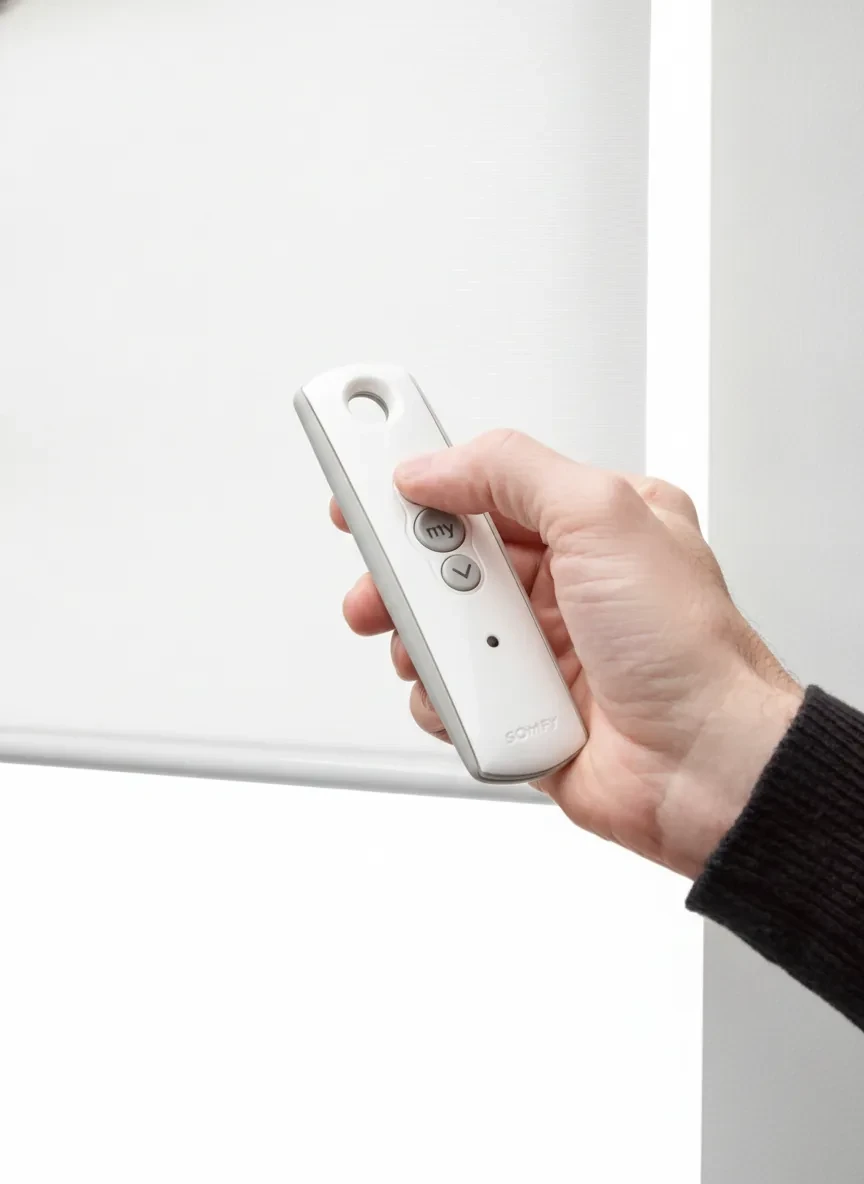
A motorised roller on a Somfy remote. No chain in the room means no chain to manage.
If you'd rather stay manual, a chain-drive blockout roller, with the safety clip fitted the way the instructions show, is what most people order for a nursery. Just fit the clip before you hang the blind, not "later".
Roller, curtain or both? A quick way to decide
| Your situation | What we'd order | Why |
|---|---|---|
| Cot room, tight budget, want it dark | Blockout roller, face fit, chain tensioner fitted | Darkest result per dollar; nothing to pull on |
| Cot room, want no cords at all | Motorised blockout roller (battery) | No loop in the room; operate from the doorway |
| Toddler room that needs to look "finished" | Blockout roller + a sheer curtain in front | Dark for sleeps, soft in the day, roller does the work |
| Room they'll have for ten years | Double curtains (sheer + blockout) | Tightest light seal of any option, and it grows with the room |
| Renting | Blockout roller, recess fit, or face fit with a pelmet | Fewer holes; take it with you — a face-fit blind needs only four screws |
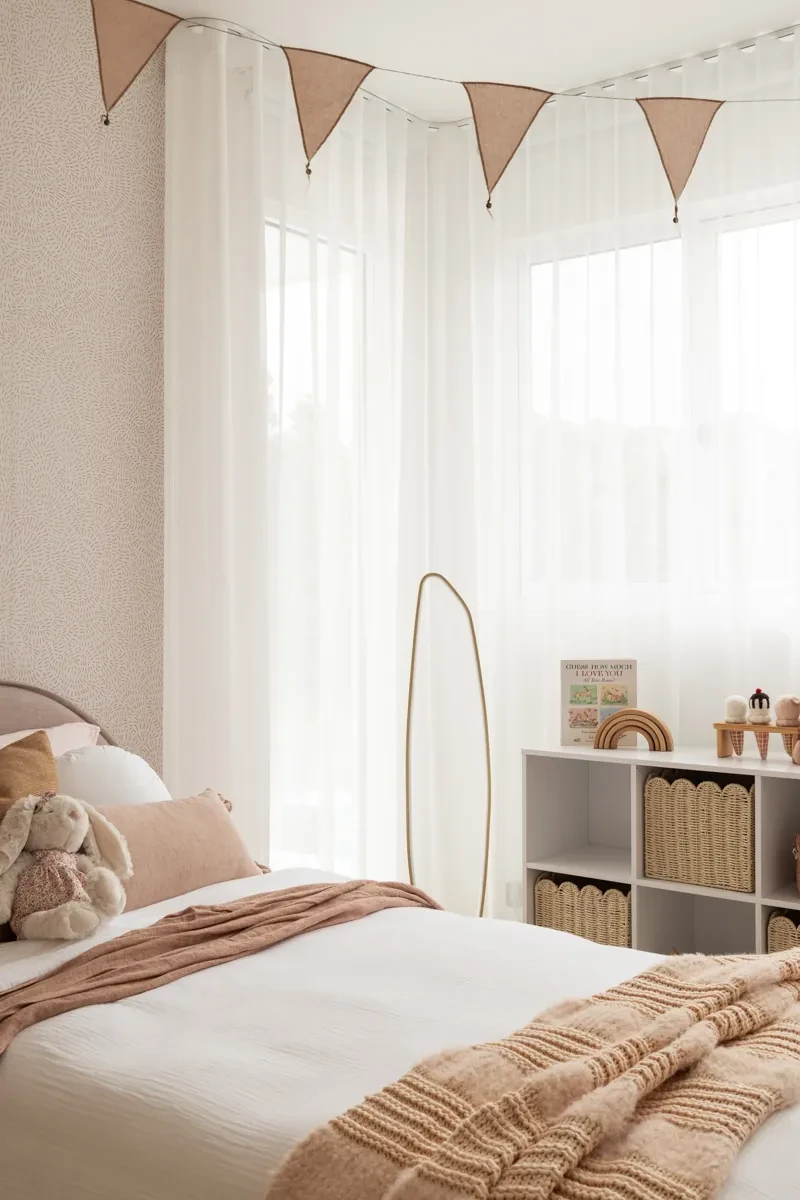
Sheers on their own (this nursery in a HAAUS build) are for the daytime look. Behind them you still want a blockout layer for sleeps.
Ordering it so it arrives before the baby does
Our blinds are made to measure in Australia and are dispatched 8–15 business days after you order. If you're working to a due date, order the samples first, then the blind, and don't leave it for the last fortnight.
- Order free samples. Two or three blockout colours. Tape them to the window at midday and look at the edges.
- Measure for a face fit. Width of the opening plus at least 50mm each side; height plus about 100mm above and enough below to clear the sill. Our measuring guide walks through it with a video.
- Configure the roller. Blockout fabric, face fit, pelmet if you want the top sealed, chain on the side away from the cot — or the motorised option.
- Install it. A drill, a level and about 20 minutes per window. We don't ship screws or plugs, because every wall is different — grab fixings rated for your surface (timber screws into a stud, a hollow-wall anchor for plasterboard, plugs for brick). Then fit the chain tensioner.
Nervous about measuring? Add the Perfect Fit Guarantee when you design your blind. It's an optional paid add-on: we video call you to check your numbers before we make it, and if it still doesn't fit, we remake it (up to five blinds per household; tell us within 14 days).
Common questions
Do I need blockout blinds for a newborn?
Newborns sleep anywhere. It's from about four to six months, when day sleeps get lighter and the room needs to be dark for them to settle, that a blockout blind earns its keep. Fit it before then and you won't be doing it with a baby in the room.
Are roller blinds safe in a nursery?
Yes, when the chain is held against the wall with the tensioner and the cot sits away from the window. A motorised roller removes the chain entirely. Venetians and verticals bring more cords into the room, so we'd steer you away from those for a cot room.
Blockout roller or blockout curtains for a baby's room?
A face-fitted blockout roller gives you most of the darkness for a fraction of the price and nothing for a toddler to hang off. Curtains seal the last few percent and look softer, at a higher cost and a longer lead time. Plenty of people do both.
What colour blockout blind is darkest?
They're all opaque through the fabric. A darker colour reads darker in the room because less light bounces around the edges. If you want a light room by day, pick the fabric colour you like and fix the edges with a face fit instead.
Can I take the blinds with me if I'm renting?
A face-fit roller hangs on two brackets and four screws. Take it down, fill the holes, and re-fit it at the next place if the window is the same size or smaller.
Order free blockout samples
Blockout, light-filtering and sheer fabrics, posted free. Then configure your blind in the roller blind builder.
You may also like

You may also like
Subscribe for new fabrics and install tips.
One email a month: new fabrics, install tips, the occasional honest before/after.
No spam, no daily-deal noise.

It’s never too early to consider window furnishings when you’re planning on renovating or building. Our expert team of design consultants can help create unique solutions and seamless designs and even quote directly off your house plans.





More Info
InspirationAbout UsContact UsOur ArticlesSuccess StoriesPerfect Fit GuaranteeDelivery InformationCustomer ReviewsFrequently Asked QuestionsGet in Touch
Address: 16 Bradwardine Road, Robin Hill NSW 2795
Email: hello@homeblindsaustralia.com.au
Phone: 1300 195 797
More Info
InspirationAbout UsContact UsOur ArticlesSuccess StoriesPerfect Fit GuaranteeShipping & Return PolicyCustomer ReviewsFrequently Asked QuestionsGet in Touch
Address: 16 Bradwardine Road, Robin Hill NSW 2795
Email: hello@homeblindsaustralia.com.au
Phone: 1300 195 797
© Copyright Home Blinds Australia 2026. All Rights Reserved.
Payments Accepted:
