



 Roller blinds
 Double roller blinds
 Roman blinds
 Venetian blinds
 Vertical blinds
 Panel blinds
 Order Free Samples
 Spare Parts
 How To Guides
 Book A Design Consultation
 Inspiration
 Upload Your Plans
 Curtains
 Double curtains
 Design PVC plantation shutters
 Design Australian PVC plantation shutters
 Design motorised roller blinds
 Design motorised curtains
 Success Stories
 Blogs
Blogs FAQ
FAQ

Bathroom Blinds: Which Ones Handle Steam, Splashes and Privacy
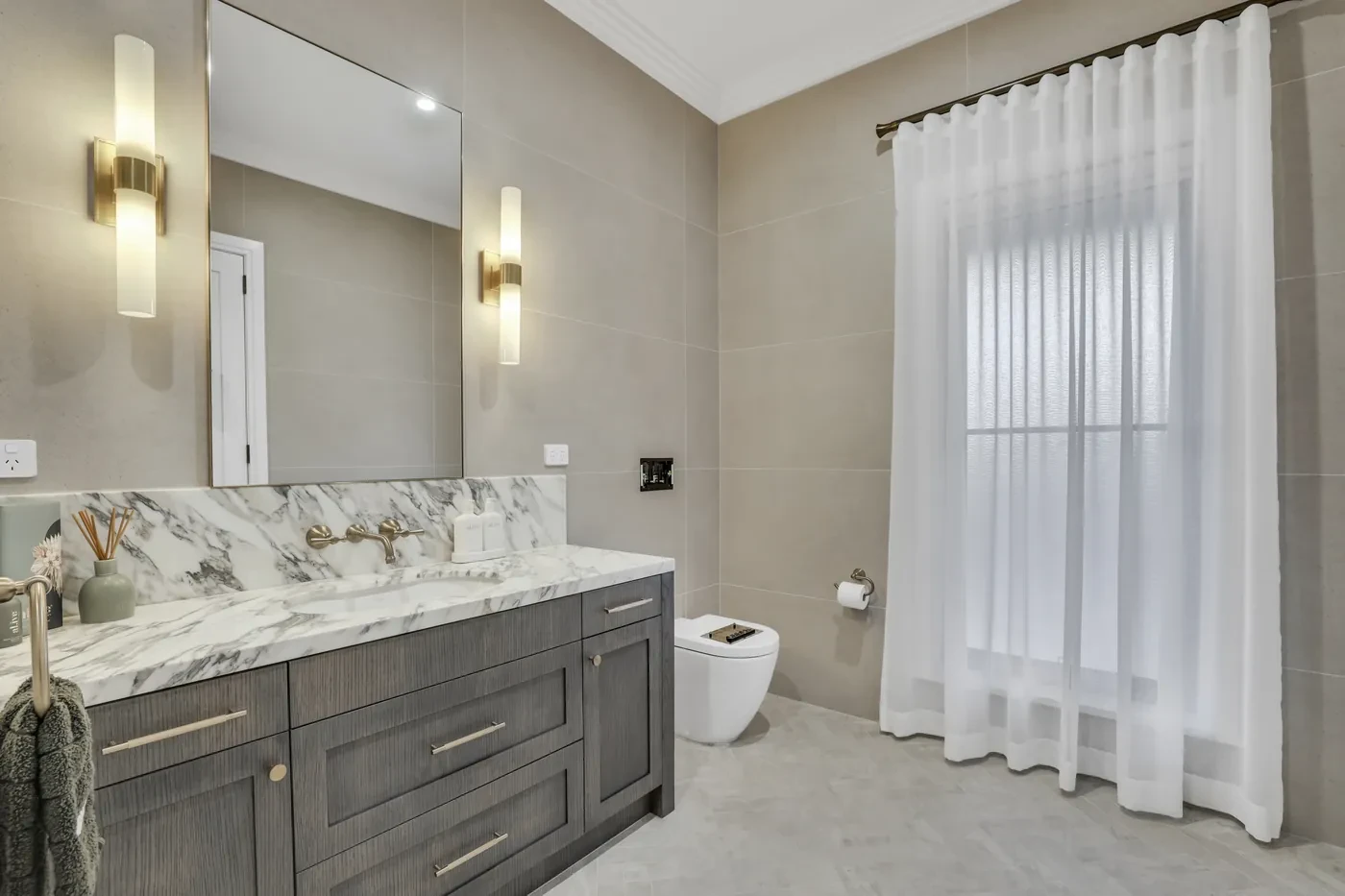
A bathroom blind has to cope with steam every day, splashes from the shower or basin, and a window someone can sometimes see into. So pick the material first. Visionwood and aluminium venetians, PVC plantation shutters, and roller blinds in our very hardy Focus or Vibe fabrics all handle a wet room and wipe down. Real timber, and fabrics you can only dust, don't belong near the shower.
We make every one of these to your measurements. You measure the window and design the blind online, we make it, and you fit it yourself.
Which blinds suit a bathroom?
Nothing that soaks up water, and a surface you can wipe. These are the ones we make for wet rooms.
| Blind | Why it works in a bathroom | Light and privacy |
|---|---|---|
| Visionwood venetian | PVC with a timber look. Moisture resistant and won’t crack like real timber | Slats tilt from full light to full privacy |
| 25 mm or 50 mm aluminium venetian | Aluminium doesn’t warp or swell. A damp cloth cleans it | Slats tilt from full light to full privacy |
| PVC plantation shutters | PVC won’t warp, crack or swell. No cords or chains | 89 mm louvres tilt. Not a blockout |
| Roller blind in Focus or Vibe | Very hardy blockout fabrics that wipe down | Full privacy, day and night |
| Sunscreen roller (One Screen or Kleenscreen) | Screen fabric that wipes clean | Keeps your view, but people can see in at night |
Venetians: Visionwood or aluminium
A venetian gives you daylight and privacy at once: tilt the slats part-way by day and close them at night. Three of our four venetians suit wet rooms:
- Visionwood is PVC with a timber look, in 50 mm or 63 mm slats. It's moisture resistant and won't crack like natural timber, so it's the way to get a timber look in a bathroom. The 63 mm slat means fewer, wider slats and a clearer view when they're tilted open.
- 25 mm slimline aluminium has slim slats that sit neatly in a small window, in 11 colours. The 50 mm aluminium venetian has wider slats in Basic White, Black Satin or Brushed Aluminium. Aluminium doesn't warp or swell, and a damp cloth cleans it.
Skip our Purewood venetians in here. They're real basswood timber, and timber is for dry rooms, away from steam. Venetians lift and tilt on cords, so fit the cord device that comes with the blind. On a door, add hold-down clips so the bottom rail doesn't swing.
PVC plantation shutters
Shutters are panels in a frame with 89 mm louvres you tilt to set the light. PVC won't warp, crack or swell, so they suit bathrooms and laundries as well as bedrooms. There are no cords or chains, and hinged panels swing open like a door when you want to clean the glass.
Two options earn their place in a bathroom. A mid rail lets you tilt the top and bottom louvres separately, so you can close the bottom half for privacy and open the top half for light (we recommend one on shutters over 1.8 m tall). A three-sided frame leaves the sill open, so you can still use it.
We make two: PVC Plantation Shutters in White or Snow White, and Australian PVC Plantation Shutters, made here with aluminium-reinforced blades, in White. Shutters aren't a blockout, as small gaps around the panels are normal. They're made to order, so allow 4 to 6 weeks.
Roller blinds: pick a fabric that wipes down
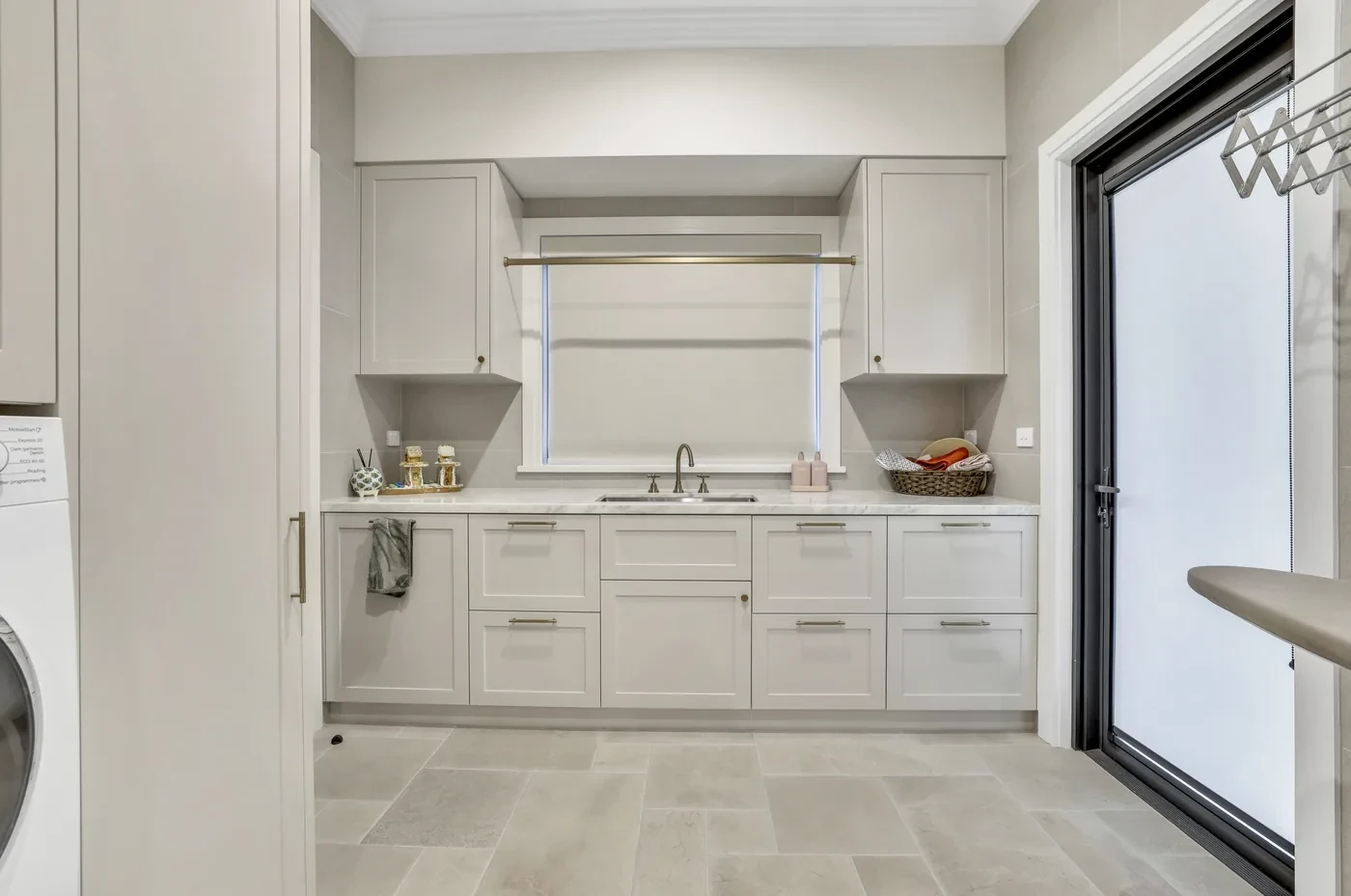
A roller is the simplest blind to measure and fit, and it works in a bathroom as long as the fabric can take a wipe. Choose Focus or Vibe. They're very hardy blockout fabrics, the ones to pick where a blind will get wet or dirty, and they wipe down with a damp cloth, lukewarm water and a little mild detergent.
Other fabrics you can wipe: One Block and Skye in blockout, Skye and Linesque in light filtering, and One Screen and Kleenscreen in sunscreen. Keep Sanctuary, Jersey, Metroshade, Balmoral and Le Reve for dry rooms, because they're dust only.
Then pick the light level by who can see in:
- Blockout gives full privacy day and night, and a dark room.
- Light filtering softens daylight and keeps your privacy. At night it glows, and someone right at the glass might make out a shape, but they can't see into the room.
- Sunscreen keeps your view and cuts glare, but with the light on at night people can see in. Use it on frosted glass, or where nobody can look in.
Pick a fabric and colour, and see your price, in the roller blind designer.
Privacy with daylight: frosted glass, louvres or fabric
Frosted or obscure glass already gives you privacy, day and night. On a frosted window, a blind is there for glare, to darken the room or just to finish the window, so a sunscreen roller or a slim aluminium venetian is plenty.
On clear glass, think about night first. With the light on inside, people can see through anything you can see through. Use a blockout or light-filtering roller, a venetian you can close, or a shutter. For daylight with the view blocked, part-tilt the slats or louvres.
Sheer curtains in a bathroom
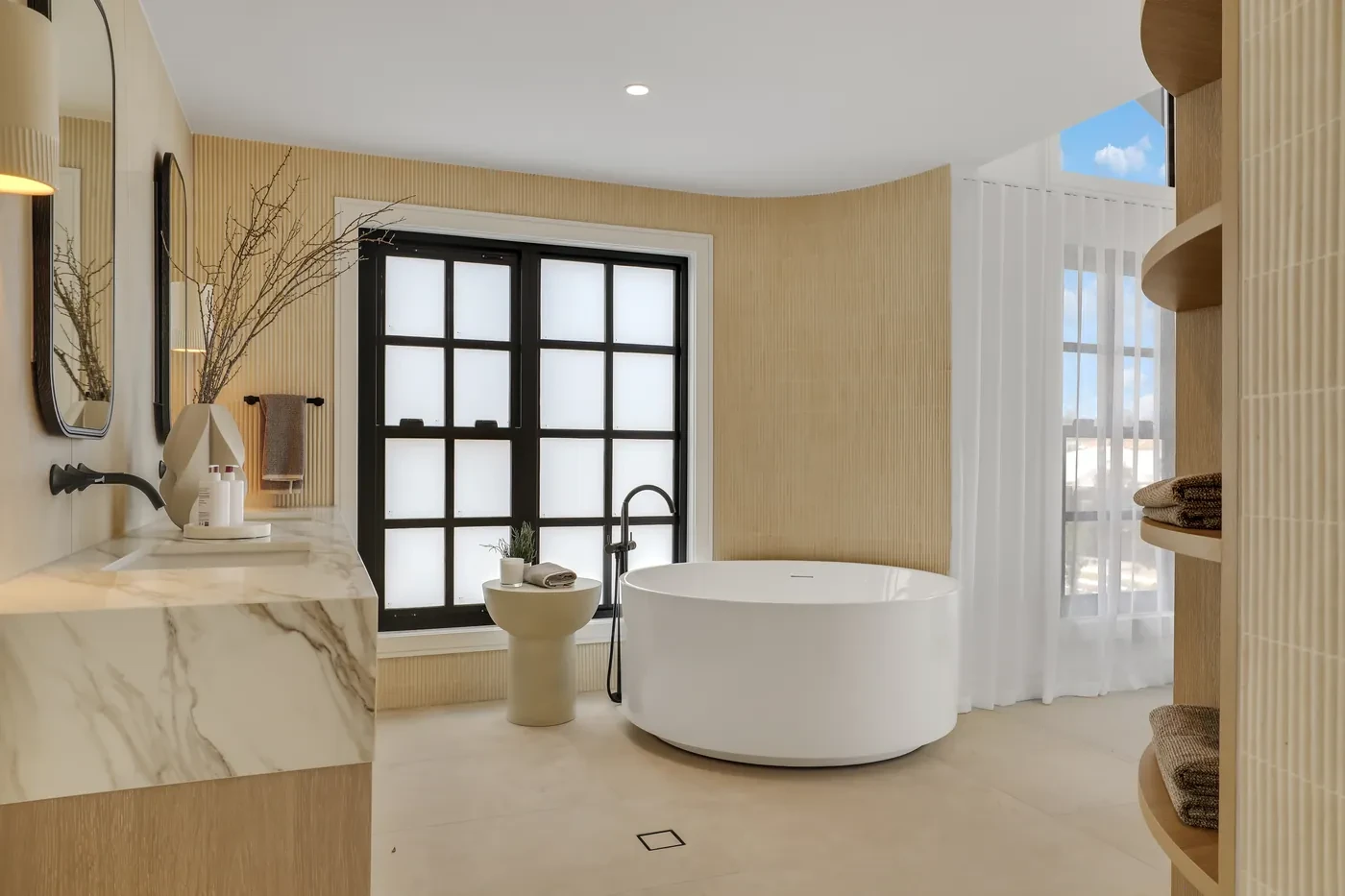
Sheers can work in a big bathroom, like this one in a Better Built Homes display home, where the curtain hangs on the dry side, well away from the shower and bath. Keep fabric out of the splash zone, run the exhaust fan, and remember a sheer on its own is see-through at night, so pair it with frosted glass or a blockout roller. In a small bathroom that steams up, use a venetian or shutter.
Steam and mould: let it dry
No blind stops mould. Fresh air does. Run the exhaust fan or open the window after a shower, leave a roller blind down until it's dry, and never roll one up damp.
Dust first, then wipe only as wet as the material allows. If mould shows up on a fabric blind, don't use bleach or a mould spray; send us a photo first. Our guide to cleaning blinds covers every fabric we sell.
Fitting a blind in a small or tiled bathroom
This is the DIY part, and bathrooms have two catches: shallow window recesses and tiles.
- Check the depth. A roller needs about 60 mm of depth to sit inside the recess, and a shutter needs at least 65 mm inside the reveal so the louvres clear the glass. Shallower than that, or tiled right up to the frame? Choose a face fit.
- Face fit onto the architrave if you can. A face-fit roller screws to the face of the timber architrave, so you never drill a tile, and it blocks more light at the edges. For a face-fit venetian, add at least 50 mm on each side, top and bottom.
- Drilling tiles? Use a tile drill bit, put masking tape over the spot so the bit doesn't wander, and drill slowly with the hammer setting off. Use wall plugs that suit what's behind the tile. We don't include fixings, because every wall is different.
- Measure in millimetres with a steel tape. For a recess fit, measure the width at the top, middle and bottom and the drop on the left, centre and right, and give us the smallest of each. Our guide to measuring for blinds has videos for common windows.
- Fit the chain tensioner. It comes with your roller blind. Screw it into something firm, like the timber window frame, not plaster.
Tiles inside a shutter reveal? Tell us in the comments box when you design it. Blinds are made in Australia to your sizes and dispatched in 8 to 15 business days, and every blind and shutter has a five-year warranty.
Which blind for which bathroom
| Room | Good choices | Skip |
|---|---|---|
| Ensuite | Visionwood venetian, PVC shutters, or a Focus or Vibe roller. A sheer is fine in a big ensuite, away from the shower | Real timber, dust-only fabrics |
| Main bathroom, window near the shower | PVC shutters, or an aluminium or Visionwood venetian | Fabric romans, curtains, dust-only fabrics |
| Laundry | A Focus or Vibe roller, or an aluminium venetian | Curtains near the tub |
| Powder room or toilet | A blockout or light-filtering roller, or a 25 mm aluminium venetian | A sheer or sunscreen on its own on clear glass |
Questions about bathroom blinds
What type of blinds suit bathroom windows?
Ones that don't soak up water: Visionwood (PVC) or aluminium venetians, PVC plantation shutters, or a roller blind in a very hardy fabric like Focus or Vibe. Skip real timber and dust-only fabrics.
Should you put blinds in a bathroom?
On clear glass, yes, or people can see in at night with the light on. On frosted glass it's up to you: people add one for glare, to darken the room or to finish the window.
Are there waterproof blinds?
Nothing we make is meant to be soaked. PVC, aluminium, and Focus or Vibe fabric handle steam and splashes and wipe down, which is what a bathroom needs.
Can I put a roller blind in a bathroom?
Yes, in a fabric that wipes down, like Focus or Vibe. Let it dry before you roll it up.
How do I fit a blind without drilling into tiles?
Face fit it. The brackets screw to the timber architrave around the window, or to the wall above the tiles, and a face fit blocks more light at the edges too.
Order free samples
Up to 10 swatches, posted free, so you can see the fabric in your own bathroom light.
You may also like

You may also like
Subscribe for new fabrics and install tips.
One email a month: new fabrics, install tips, the occasional honest before/after.
No spam, no daily-deal noise.

It’s never too early to consider window furnishings when you’re planning on renovating or building. Our expert team of design consultants can help create unique solutions and seamless designs and even quote directly off your house plans.





More Info
InspirationAbout UsContact UsOur ArticlesSuccess StoriesPerfect Fit GuaranteeDelivery InformationCustomer ReviewsFrequently Asked QuestionsGet in Touch
Address: 16 Bradwardine Road, Robin Hill NSW 2795
Email: hello@homeblindsaustralia.com.au
Phone: 1300 195 797
More Info
InspirationAbout UsContact UsOur ArticlesSuccess StoriesPerfect Fit GuaranteeShipping & Return PolicyCustomer ReviewsFrequently Asked QuestionsGet in Touch
Address: 16 Bradwardine Road, Robin Hill NSW 2795
Email: hello@homeblindsaustralia.com.au
Phone: 1300 195 797
© Copyright Home Blinds Australia 2026. All Rights Reserved.
Payments Accepted:
