



 Roller blinds
 Double roller blinds
 Roman blinds
 Venetian blinds
 Vertical blinds
 Panel blinds
 Order Free Samples
 Spare Parts
 How To Guides
 Book A Design Consultation
 Inspiration
 Upload Your Plans
 Curtains
 Double curtains

 Design PVC plantation shutters
 Design Australian PVC plantation shutters
 Design motorised roller blinds
 Design motorised curtains
 Success Stories
 Blogs
 FAQ

How to Measure for Curtains: Width, Drop and Where the Track Goes
To measure for curtains, measure the track, not the window. Decide where the track goes, run it at least 150 mm past the window frame on each side, then measure the drop from the track line down to the floor. That's two numbers in millimetres, width first. It's a DIY job: you measure, we make the curtains to your sizes in Australia, and you hang them yourself.
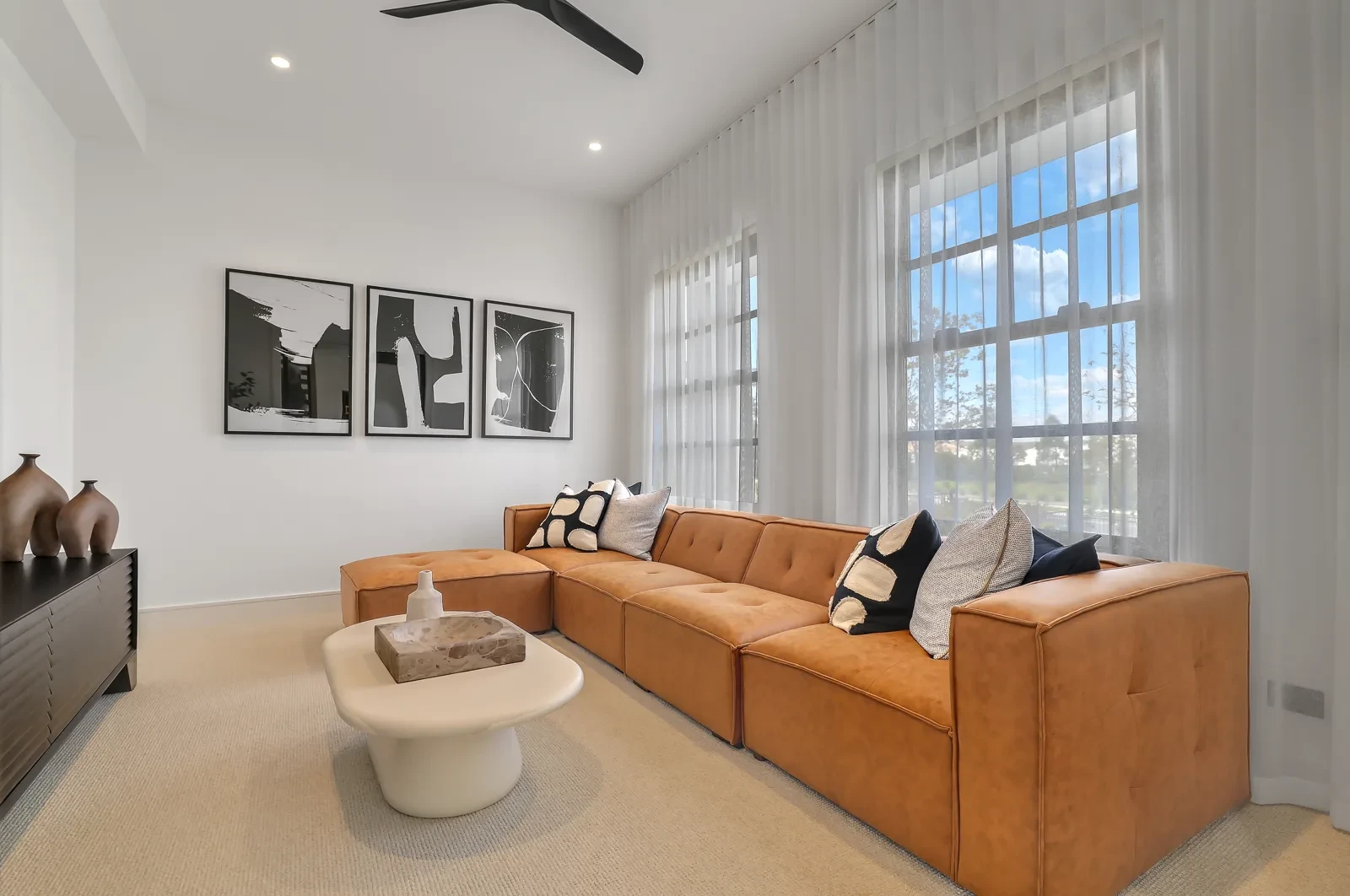
How to measure for curtains, step by step
- Choose where the track goes: on the ceiling (top fit) or on the wall above the window (face fit).
- Mark each end of the track at least 150 mm past the window frame, on the left and on the right.
- Measure the width between your two marks, along the track line. That's the track length, and it's the width you enter.
- Measure the drop from the track line down to the floor at the left, the centre and the right. Note the shortest.
- Write both in millimetres, width first, with nothing taken off and nothing added on.
- Enter them in the curtain designer, then choose which way it opens and how it meets the floor.
It takes a few minutes a window. Measure every one, even if two look the same.
What you need
- A steel tape measure. Cloth tapes stretch.
- A pencil and paper, or the notes app on your phone.
- A step ladder for a ceiling track, and a second person for a wide window.
- A name for each room. The designer asks for it, and it's printed on the packaging so each curtain goes to the right window.
The two numbers: track width and drop
The width is the length of the track, not the window. The drop is the height from the track down to the floor. You don't measure for fabric: a curtain uses more fabric than the track is long so it can hang in folds, and we work that out from your track width.
Here's a 2 m window with the track on the ceiling:
| What you measure | Example |
|---|---|
| Window, across the outside of the frame | 2,000 mm |
| At least 150 mm past the frame on each side | + 300 mm |
| Width to enter (the track length) | 2,300 mm |
| Drop from the ceiling to the floor, shortest of three | 2,695 mm |
| Drop to enter | 2,695 mm, exactly as measured |
We make curtains from 800 mm to 5,750 mm wide and from 900 mm to 4,000 mm drop.
Ceiling or wall: where the track goes
Ceiling track (top fit)
The track screws up into the ceiling. It's the cleanest look, and a curtain that runs from the ceiling to the floor makes the room feel taller. Measure the drop from the ceiling, where the track will go, to the floor. If a cornice or bulkhead sits on that line, call us on 1300 195 797 before you order.
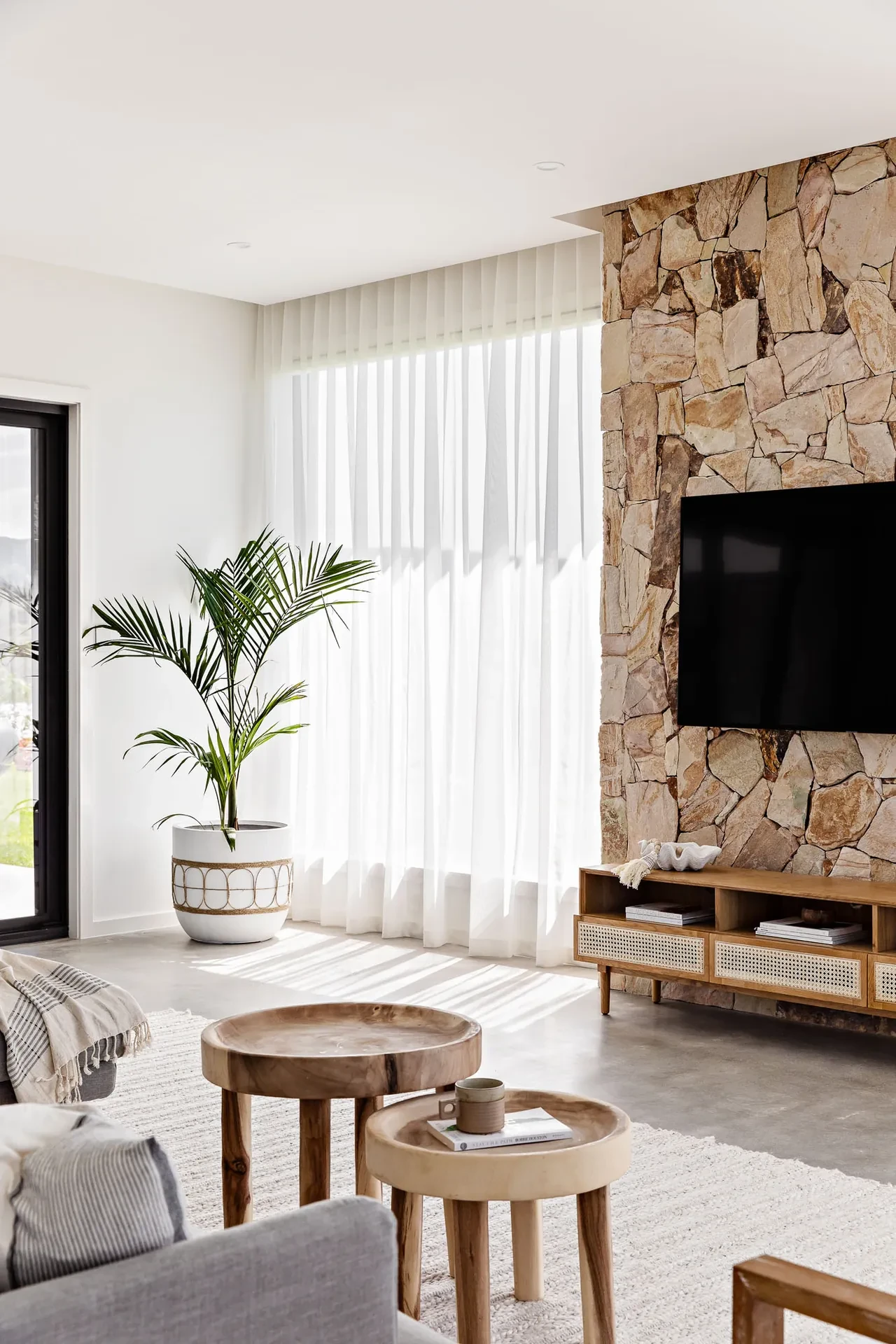
Wall track (face fit)
The brackets screw to the wall above the window. Choose it when the ceiling is too high or slopes, or when you want the curtain to start at the architrave (the timber trim around the window).
Mark the height for the track first, then measure the drop from that mark, not from the top of the window or the glass. With more than one window in a room, put every track at the same height so the hems line up.
Bay window, corner window, or a window hard up against a side wall? Call us before you order and we'll talk it through.
How far past the window should curtains go?
At least 150 mm past the frame on each side. When a curtain is open, the fabric bunches up at the end of the track. That bunch is the stack. Running the track past the frame gives the stack somewhere to sit, so the open curtain clears the glass instead of covering part of the view. Go further if the wall allows: the wider the curtain, the bigger the stack.
- One curtain that stacks left or right: all the fabric ends up on one side, so give that side the extra room. Stack it away from a door, or from the part of the view you use most.
- A centre-opening pair: half the fabric goes to each side. You still enter one width for the whole track.
- Check both ends: a corner, a door frame, a light switch or an air-con unit can stop the track short.
Floor-length or sill-length?
Our curtain designer is set up for floor-length curtains. Every curtain asks how the hem meets the floor:
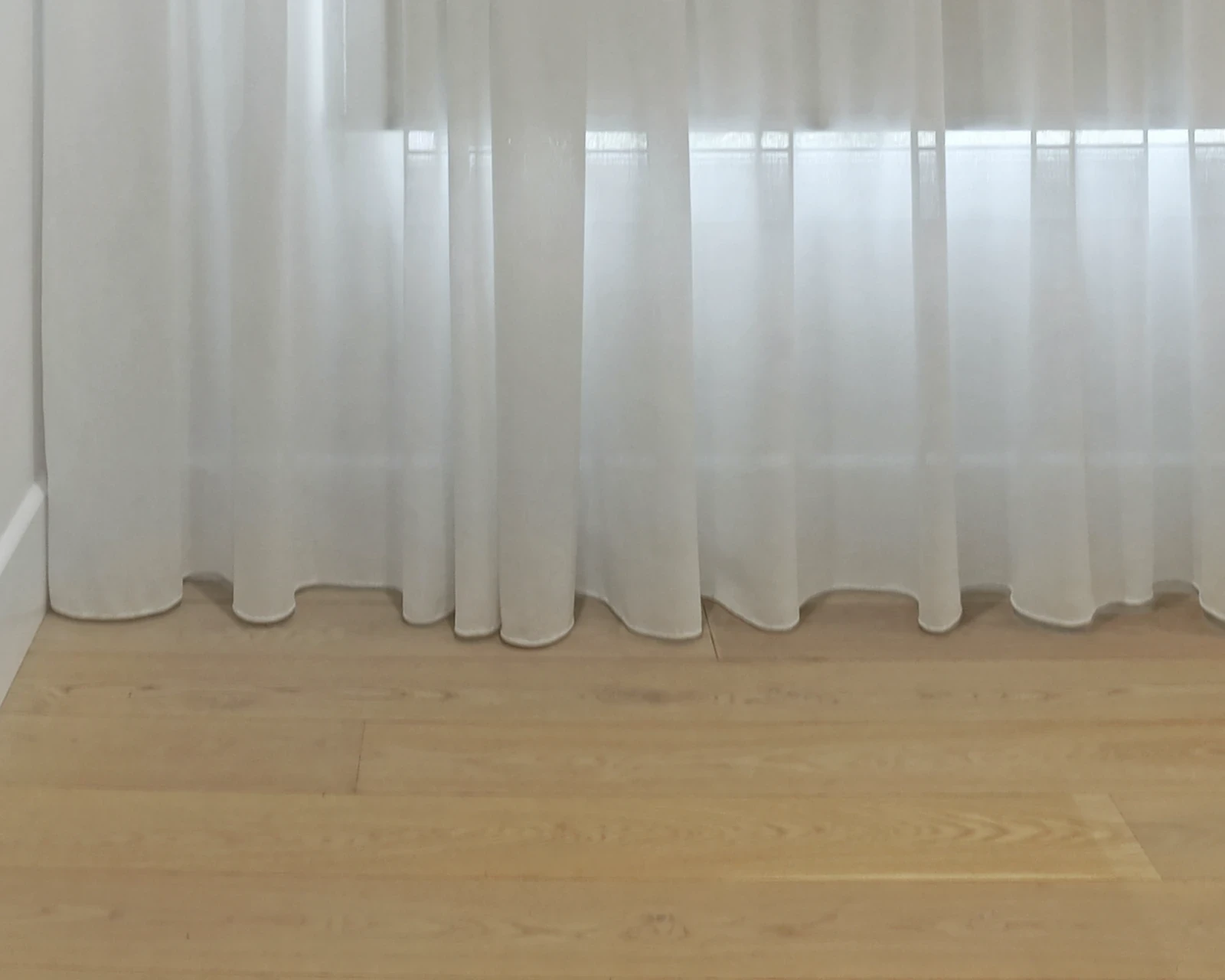
- 20 mm off the floor: clears rugs and the vacuum. The everyday choice.
- Touching the floor: the hem just meets the floor, so measure carefully.
- Puddled: we add 20 mm to the drop, so the fabric breaks softly on the floor.
Measure the drop to the floor and enter it exactly as you measured it. Then pick the finish. The designer tells you how each one is made, and we check every order before it goes to the workshop.
Want a curtain that stops at the sill? Call us on 1300 195 797 before you order. For a short window over a bench or sink, a blind is often the simpler fit, and our guide to measuring for blinds covers it.
Tall drops
We make drops up to 4,000 mm. If yours is over 3 m, call us before you order and we'll talk you through the fabric. On a tall drop, pick a longer wand (1,220 or 1,520 mm) so it's within reach.
S-fold or pinch pleat: does it change how you measure?
No. You give us the same two numbers for every heading. The heading is the style at the top of the curtain, and it changes how much fabric goes in, not the size you measure.
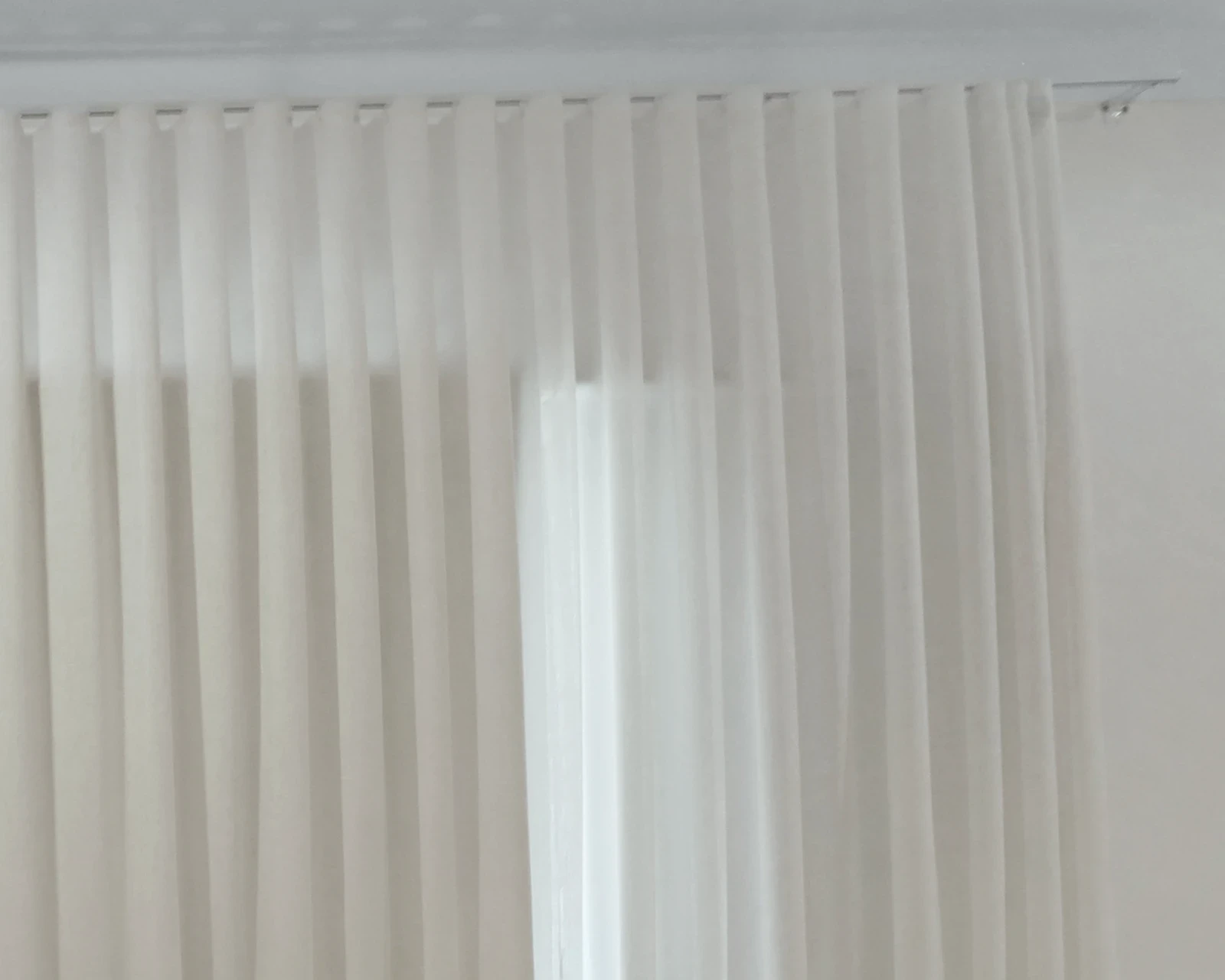
S-fold curtains hang in soft, even waves and stack back tightly. Pinch pleat curtains have the fabric stitched into small groups of folds along the top, in pairs or threes, and a triple uses a little more fabric than a double. Either way, you enter the track width and we allow for the fabric.
Measuring for double curtains (sheer and blockout)
Double curtains hang a sheer and a blockout on one double track. You measure once: one width and one drop, and both curtains are made to that size, within the same 800 to 5,750 mm width and 900 to 4,000 mm drop.
Then you set up each curtain on its own: fabric, heading, which way it opens, hem and how it meets the floor. The back curtain sits closest to the glass and is usually the blockout, so the sheer in front can stay closed through the day. There's also a custom clearance option, where you tell us the gap you want in the order notes. Design your double curtains once you have your numbers.
Existing track or a new one?
Every curtain we make comes with its own track, cut to your width, so the heading and the track match. We don't make curtains to hang on a track you already have.
So measure for the new track. Work out how long you want it, and measure the drop from that line. Don't measure the old curtain: fabric can shrink or stretch, and it was made with its own allowances. The new track can go where the old one was. Take the old one down first, and plan to fill the old screw holes, as they may not line up with the new brackets.
Common measuring mistakes
- Measuring the window, not the track. The curtain comes out too narrow to clear the glass.
- Centimetres instead of millimetres. 240 cm is 2,400 mm. Write millimetres every time.
- Taking your own allowances off. Enter the drop exactly as you measured it, then choose the floor finish.
- Measuring before the new floor goes down. New carpet or boards change the drop.
- Assuming two windows are the same. They rarely are.
Check the fabric at your window with free samples
While the tape's out, order free curtain samples. You can have up to 10, posted free, and they never hold up an order. Hold each one flat against the wall beside the window, in daylight and again at night. Whites are the tricky ones: a white curtain next to a cream wall can look grey.
After you measure: order it, then hang it yourself
Enter your width and drop in the curtain designer and the price updates as you choose. We check every order before it goes to the workshop and call you if a number looks odd. For a second check, add the Perfect Fit Guarantee, a paid add-on: we video call you to check your measurements before we make the curtain.
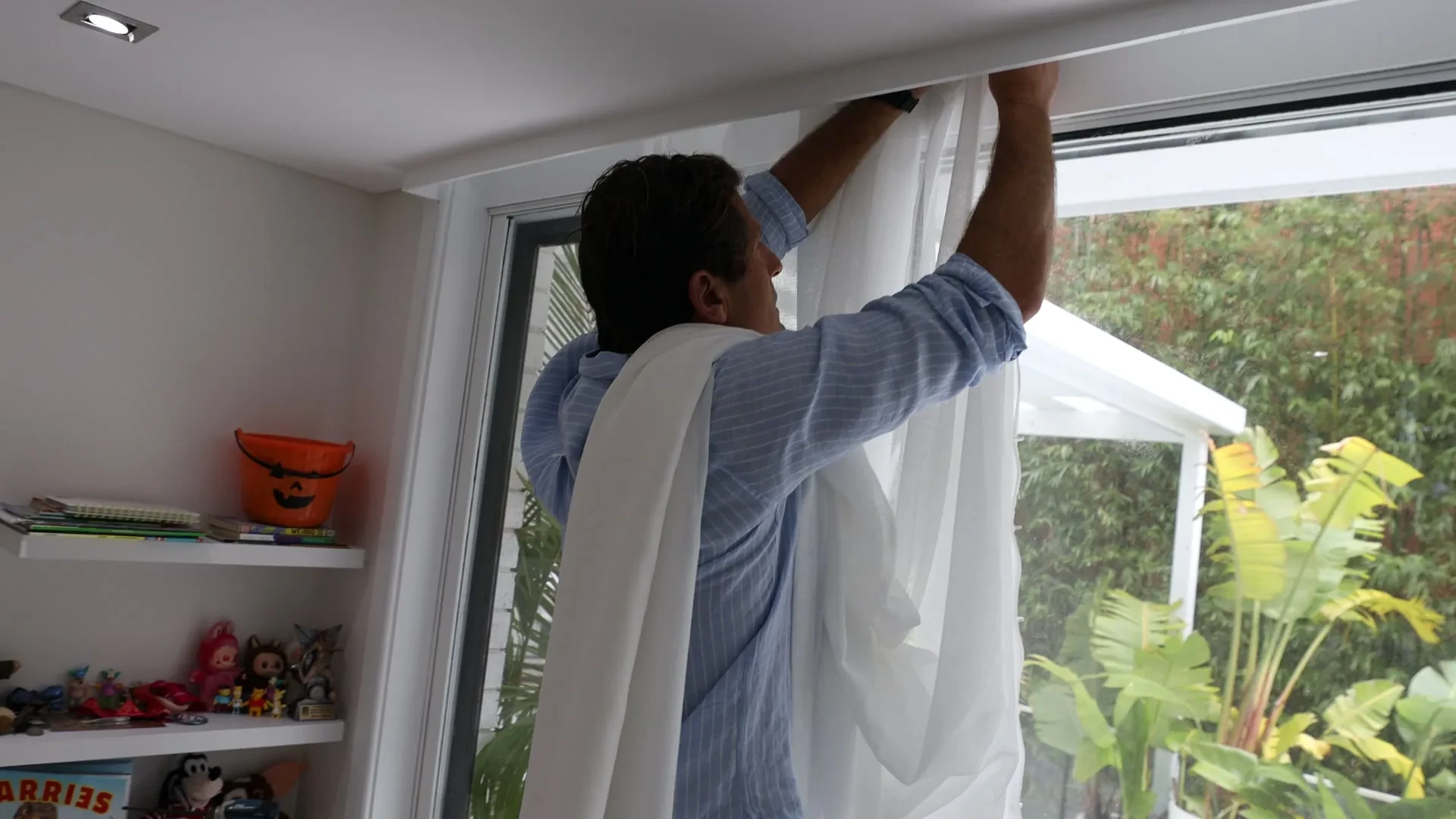
The track comes with brackets and instructions, and the curtain arrives ready to hook on. Have the right screws and plugs for your wall or ceiling ready. A track is an overhead job for two people, and most people do a room in an afternoon with a drill and a level. How it works covers ordering and fitting, and new hooks or pendants are in curtain spare parts.
Questions
How do you measure what size curtains you need?
Two numbers in millimetres: the track width, running at least 150 mm past the window frame on each side, and the drop from the track line to the floor. We work out the fabric.
What size curtains do I need for a 180 cm or 200 cm window?
For a 200 cm (2,000 mm) window, make the track at least 2,300 mm: the window plus 150 mm on each side. For a 180 cm window, at least 2,100 mm. Go wider if the wall allows. The drop depends on where the track goes, not on the window.
How do you read curtain measurements in Australia?
Width × drop, in millimetres, width first. 2,300 × 2,695 means a track 2,300 mm long and a drop of 2,695 mm. Comparing with another quote? Check it's in millimetres too.
Should curtains touch the floor?
It's your call. In our designer you choose 20 mm off the floor, touching the floor, or puddled, where we add 20 mm to the drop. 20 mm off is the practical choice, and touching needs careful measuring.
Can I measure before the track is up?
Yes, that's the usual way. Mark where the track will go and measure from your marks. Your curtain comes with its own track, cut to your width.
Design your curtains
Enter your track width and drop and see the price as you go. We make them to your sizes in Australia, and you hang them.
You may also like

You may also like
Subscribe for new fabrics and install tips.
One email a month: new fabrics, install tips, the occasional honest before/after.
No spam, no daily-deal noise.

It’s never too early to consider window furnishings when you’re planning on renovating or building. Our expert team of design consultants can help create unique solutions and seamless designs and even quote directly off your house plans.





More Info
InspirationAbout UsContact UsOur ArticlesSuccess StoriesPerfect Fit GuaranteeDelivery InformationCustomer ReviewsFrequently Asked QuestionsGet in Touch
Address: 16 Bradwardine Road, Robin Hill NSW 2795
Email: hello@homeblindsaustralia.com.au
Phone: 1300 195 797
More Info
InspirationAbout UsContact UsOur ArticlesSuccess StoriesPerfect Fit GuaranteeShipping & Return PolicyCustomer ReviewsFrequently Asked QuestionsGet in Touch
Address: 16 Bradwardine Road, Robin Hill NSW 2795
Email: hello@homeblindsaustralia.com.au
Phone: 1300 195 797
© Copyright Home Blinds Australia 2026. All Rights Reserved.
Payments Accepted:
